 Florence City Guide
The 1966 Flood: What Florence Lost, and What It Saved
The 1966 flood in Florence is the reason a great many things in this city are where they are: why Cimabue's Crucifix hangs in a sacristy rather than a refectory, why Ghiberti's Baptistery doors are sealed in a case of inert gas inside a museum, why a national library still holds thirty thousand books nobody can request. It is also the most legible piece of history in the city for a visitor, because the city marked it: 131 plaques from that flood alone are catalogued in the historic centre, and you can walk between them in an afternoon (see what to see in Florence). This page sets out what happened, what the institutions themselves say was lost, where the published figures contradict each other, and which walls carry the marks. Every figure below is attributed to the body that publishes it.
Quick answer What happened, the figures that are contested, and the walls to walk to
The Arno came over its banks into the city at about 02:30 on 4 November 1966 and peaked around 05:30. The highest mark recorded on a wall in the historic centre is 4.92 metres, at Via San Remigio by Via dei Neri — seventy centimetres above the mark left by the flood of 1333 on the same corner. The death toll, the peak discharge and the damage totals are all genuinely contested between official bodies, and this page publishes the disagreements rather than picking a number.
Key takeaways
- The Arno Basin Authority's catalogue counts 153 flood plaques in the historic centre: 131 from 1966, 12 from 1844, 4 from 1557, 3 from 1333, 2 from 1740 and 1 from 1547
- The water was about 4.4 metres deep on Piazza Santa Croce and 1.5 to 2 metres at the Duomo — the two churches are ten minutes apart and the marks are on their walls
- Cimabue's Crucifix lost 60 per cent of its painted surface and now hangs in the Sacristy of Santa Croce, moved there in 2013 as protection against the next flood — a Santa Croce guided visit covers the complex
- Ghiberti's original Gates of Paradise are in the cathedral museum, in a sealed nitrogen case; what is on the Baptistery today is a copy fitted in 1990
- The National Central Library still holds around 30,000 flood-damaged volumes that cannot be requested; the city began a public recovery project on them in May 2026
The night of 4 November 1966
Ten days of continuous rain had already fallen on the Arno basin when the storm of 3 and 4 November arrived. The city's Civil Protection office records an average of 160 millimetres in twenty-four hours across the whole basin, with local peaks of 250 to 300 millimetres; at Badia Agnano in the Ambra valley, 437.2 millimetres fell in forty-eight hours, a Tuscan record that has never since been beaten.
The Uffizi's own account puts the moment the river came into the city at 02:30. The Arno Basin Authority puts the peak at about half past five that morning, with a second, slightly lower peak at two in the afternoon. The Ponte Vecchio's channel could carry something between 2,200 and 2,300 cubic metres a second; what arrived was more than four thousand. The Comune's civil-protection page calculates that over seventy million cubic metres of water entered Florence as a result.
The national Civil Protection Department describes a three-metre wave running through the streets at sixty kilometres an hour, more than nine thousand fire-brigade interventions on the night of 4 and 5 November, and a river that withdrew on 6 November leaving six hundred thousand tonnes of mud behind it. Fifteen hundred square kilometres of the nine-thousand-square-kilometre basin were under water.
The fuel oil is the part people forget
It was the beginning of November, which in Florence means every domestic heating tank in every cellar in the city had just been filled. The tanks went under with everything else, and the flood that came up through the floors was not water and mud but water, mud and naphtha. The Uffizi's own description of its damaged works is that they were "completely soaked in water, naphtha and mud", with "mud and fuel oil from the heating systems scattered everywhere".
That is why the damage was chemical rather than merely physical, why paint lifted from panels rather than simply getting wet, and why the restoration took decades rather than seasons. It is also why the tide line on the walls is a stain as much as a level.
How high the water stood, wall by wall
Every height below is the figure inscribed on that plaque, taken from the Arno Basin Authority's own catalogue of the flood markers of the historic centre.
| Where the plaque is | 1966 mark | Earlier flood on the same wall |
|---|---|---|
| Via San Remigio at Via dei Neri | 4.92 m — the highest in the city | 1333: 4.22 m |
| Via Ghibellina at Via delle Casine | 4.90 m | None recorded |
| Piazza Mentana | 4.60 m | None recorded |
| Via de' Benci | 4.50 m | None recorded |
| Via Verdi 9 | 4.50 m | 1844: 1.67 m |
| Piazza Santa Croce, both sides | 4.40 m | 1557: 3.50 m, on the Via Verdi corner |
| Via dei Leoni | 4.35 m | 1844: 1.75 m |
| Largo Piero Bargellini at Via delle Pinzochere | 4.30 m | None recorded |
| Piazza Sant'Ambrogio, on the church front | 4.21 m | 1844: 1.00 m |
| Church of San Niccolò, Oltrarno | 4.20 m | 1557: 3.92 m |
| Borgo Ognissanti 91r | 2.50 m | 1844: 1.50 m |
| Piazza del Duomo at Via de' Cerretani | 2.00 m | None recorded |
| Piazza Santa Maria Novella at Via della Scala | 2.00 m | None recorded |
| Via dell'Oriuolo at Piazza del Duomo | 1.50 m | None recorded |
| Via de' Bardi, Oltrarno | 1.70 m | None recorded |
Where an earlier flood is recorded on the same wall, it is in the third column — those pairs are the reason this is worth walking rather than reading. The Authority's own summary sheet also tabulates water depths that differ slightly from the inscribed heights — 4.63 m in Via dei Leoni against the plaque's 4.35 m, for instance. The plaque values are used here, because those are the ones you can stand in front of.
The figures that do not agree
This is the part of the story most retellings smooth over. Four separate Italian institutions publish four different sets of numbers, and in one case a single body contradicts itself between its own website and its own PDF.
The gauging station on the Arno was destroyed during the event, so the Basin Authority states plainly that any estimate of the peak discharge at Florence "is affected by inevitable uncertainty". That single fact explains most of what follows: nobody measured the river at its worst, because the instrument that would have measured it was swept away.
| What | The published figures | Who says so |
|---|---|---|
| Peak discharge | 4,100 m³/s · about 4,000 m³/s · 3,600 m³/s | Comune di Firenze civil protection · Arno Basin Authority · Ministry of Public Works, from flood traces |
| Deaths, contemporary count | 33 · 34 · 35 · 37 | Interior Ministry first count, 9 November 1966 · Civil Protection Department PDF · Civil Protection Department website and the Uffizi · the Prefect of Florence's list, 29 November 1966 |
| Deaths, modern reconstruction | 19 in the city, 38 in the province, 47 in Tuscany | CNR-IRPI's POLARIS archive, which counts deaths from consequences and rescue work as well as direct causes |
| Water at Santa Croce | 6 m as a district figure · 4.40 m on the plaque | The Uffizi · the Arno Basin Authority's plaque catalogue |
| Cimabue Crucifix paint loss | 60 per cent | Opera di Santa Croce and the Uffizi, independently; a 70 per cent figure circulates without an institutional source |
| Baptistery panels torn off | Five, or six, of the ten | Accounts differ. Neither the Opera del Duomo nor the Opificio delle Pietre Dure could be read directly |
Two numbers you will see everywhere and will not find here
"Fourteen thousand works of art" and "three to four million books" are the figures repeated in almost every article about the flood. We could not find either of them on the website of a single Italian institution — not the Uffizi, not the National Central Library, not the Civil Protection Department. They may well be right. They are not sourced, so they are not printed here.
The National Library's own numbers are better anyway, and they are worse: about a million bibliographic units submerged, roughly a hundred thousand volumes from the historical collections severely damaged, six million catalogue cards ruined, and between 24,000 and 27,000 of some 37,000 newspaper titles hit, with eight to ten per cent of that collection lost outright.
The library in the cellar
The Biblioteca Nazionale Centrale stands in Santa Croce, at what the Civil Protection Department describes as the morphologically lowest point of Florence. Its basement, ground floor and mezzanine went under more than four metres of muddy water. What had been in that basement was the library's most precious material — the large-format Palatine volumes, the Magliabechiano collection, the miscellanies — and it was there for a reason that is hard to read now without wincing.
The books had been moved down to the cellars in 1938, to protect them from bombing. The measure that saved them from one war is what put them under the Arno twenty-eight years later. Sixty years on the work is unfinished.
Around thirty thousand volumes, mostly miscellanies and pamphlets, are still held in an external depot and cannot be requested by readers. the Comune announced a community project with citizens and students to work through them. The restoration centre that Florence improvised in the weeks after the flood became, in the 1970s, the model that the rest of the world copied for treating water-damaged paper.
What the water took, and what it accidentally gave back
Cimabue's Crucifix
The great painted cross Cimabue made before 1288 for Santa Croce — tempera and gold on wood, 433 by 390 centimetres — was submerged, fouled with mud and carried out of the church on an improvised trolley. It lost sixty per cent of its painted surface, a figure that the Opera di Santa Croce and the Uffizi state independently of each other. It went first to the Limonaia in the Boboli Gardens, converted overnight into an emergency restoration centre, and then to the Opificio delle Pietre Dure's laboratory at the Fortezza da Basso.
It hangs today in the Sacristy of Santa Croce, on the visitor route through the monumental complex. It was moved there in 2013 for one reason: the sacristy is higher, and the next flood is a question of when. That is the most quietly eloquent thing in the basilica — an object still being arranged around an event sixty years old.
Donatello's Magdalene, and the gilding nobody knew was there
Donatello's Penitent Magdalene had stood in the Baptistery since about 1500. The flood damaged it, it was moved to the cathedral museum, and the restoration the damage forced removed a later monochrome overpaint — revealing the original polychromy underneath, traces of gold and red in the hair that had been considered lost. The wooden figure that visitors see now looks the way it does because of the flood.
The same is true, at a larger scale, of Ghiberti's east doors of the Baptistery. Panels were torn from the bronze frame by the water — accounts differ on whether five or six, and neither the Opera del Duomo nor the Opificio could be read directly to settle it. What is not in dispute is where they are: a copy has stood on the Baptistery since 1990, and the restored originals are displayed in the Museo dell'Opera del Duomo, reassembled in their frame inside a sealed case filled with inert nitrogen so that the bronze cannot oxidise again. They will not travel.
The Uffizi, and one story worth correcting
The Uffizi's ground floor took the worst of it: a major works depository in San Pier Scheraggio, the restoration laboratories, and the Photographic Department in the old post building, where shelving stood submerged to a metre and a half. More than twenty thousand negatives were damaged, most of them eventually recovered, and staff shot over a thousand photographs documenting the damage as it happened.
The popular version of the story has works carried to safety along the Vasari Corridor. The Uffizi's own account says something close to the opposite: the corridor held the self-portrait collection, and paintings were taken out of it because it "seemed on the edge of collapse together with Ponte Vecchio". The corridor was a danger, not an escape route. The flood swept over the parapets of the bridge itself and destroyed many of the shops on it — which is why Ponte Vecchio has almost nothing on it older than that night except the bridge.
The mud angels, and where the phrase came from
"Angeli del fango" was coined by the journalist Giovanni Grazzini in the Corriere della Sera of 10 November 1966, in an article titled "Si calano nel buio della melma" — they lower themselves into the darkness of the mud. The Civil Protection Department reproduces his line in its own publication on the flood: from now on nobody will be permitted to sneer at the young beats. Honour to the beats, honour to the mud angels.
The phrase, in other words, was born as a defence. The volunteers who arrived from all over Italy and beyond — thousands of them, long-haired and unofficial — were exactly the young people the newspapers had been mocking for a decade. They shovelled mud, carried water and food, and pulled books and panel paintings out of cellars for weeks. The Department names Ted Kennedy, Margherita Hack, Gerhard Schröder and Joschka Fischer among them, and Robert Kennedy appears in Zeffirelli's short film Per Firenze appealing for help.
The University of Florence founded an archive for them in 2016, the Archivio degli Angeli del Fango at its flood documentation centre, which by then had more than six hundred registered names. Italian civil-protection volunteering as an organised national institution is generally traced back to what those weeks improvised.
Where a visitor can see it today
Four stops, none of them a museum of the flood — there is no such museum in Florence, and the Museo di Firenze com'era, which people still look for, closed permanently in 2010.
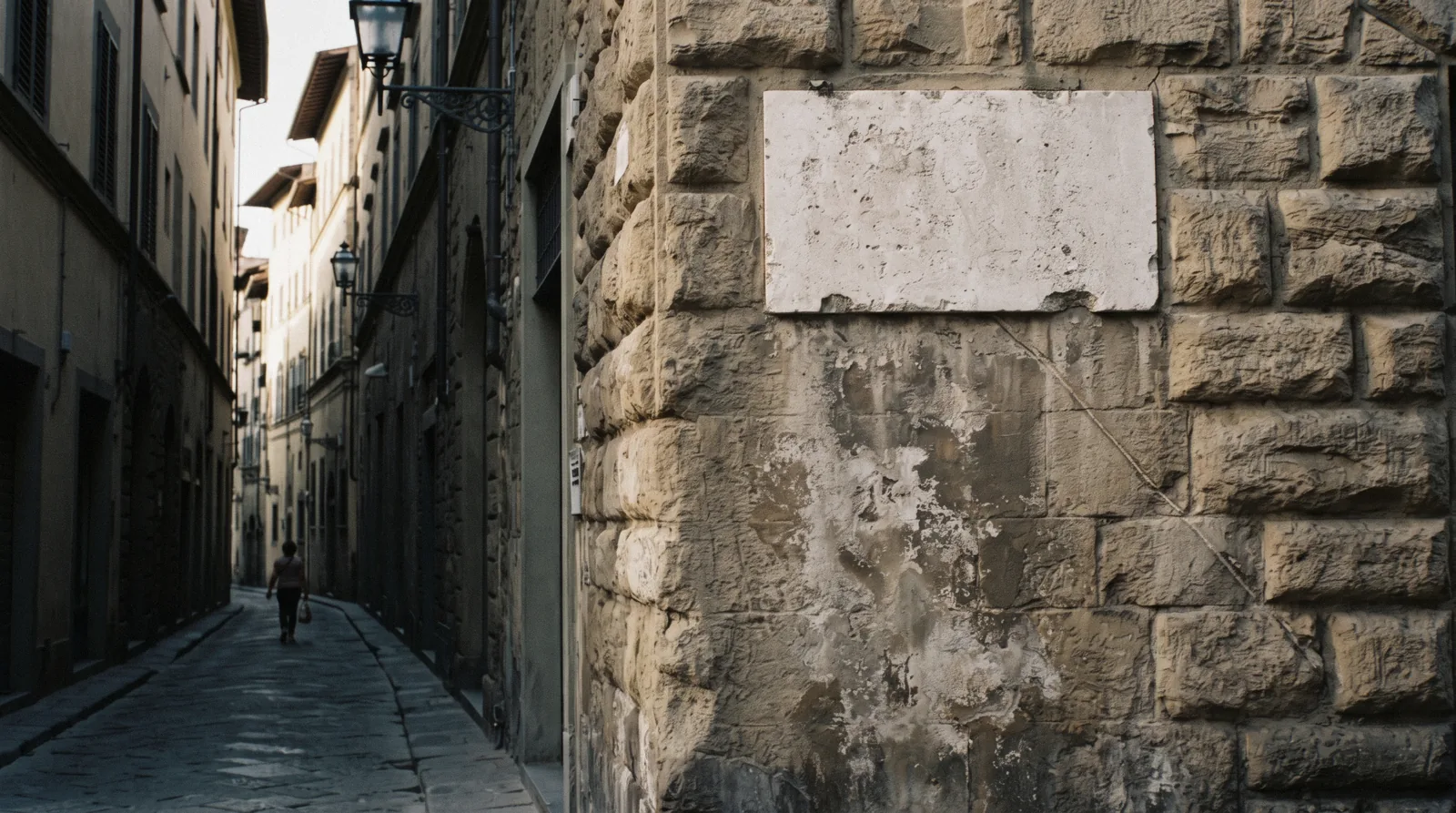
Start at the corner of Via San Remigio and Via dei Neri, two minutes east of Piazza della Signoria. Two plaques sit on the same wall, one above the other: 1333 at 4.22 metres and 1966 at 4.92. Stand under the higher one and look at where your head is.
Nothing else in the city makes the scale of it comprehensible so quickly. Walk on to Piazza Santa Croce, five minutes east. The 1966 marks on both sides of the square read 4.40 metres, and on the Via Verdi corner the 1557 flood is recorded at 3.50. Santa Croce itself is the second stop: the Crucifix in the Sacristy, and the basilica floor that the water stood on.
The complex opens Monday to Saturday from 09:30 to 17:30 and Sunday from 14:00, at €10 (about $12) with a reduced €6 for ages 12 to 17 and students. Then go to the Duomo and find the plaque at the corner of Via de' Cerretani, which reads 2.00 metres, and the one on Via dell'Oriuolo at 1.50. The distance between Santa Croce and the cathedral is ten minutes on foot.
The difference between the marks is nearly three metres, and it is the clearest lesson in the topography of this city that anyone will ever get for free. Finish inside the Museo dell'Opera del Duomo with the Gates of Paradise, where the restoration of the damage is the exhibit. For the sixtieth anniversary, the Archivio di Stato di Firenze has announced an exhibition, RI-EMERGERE 1966–2026, running from 4 November 2026 to 6 February 2027 with free admission and compulsory reservation, and the Comune has signed a protocol for commemorations at Palazzo Vecchio through October and November 2026.
Neither programme was open when this page was written, and the Sala d'Arme dates have not been published, so check before you plan around them. Once you have traced the marks on your own, florence guided tours can take you deeper into the stories behind the streets and buildings this flood route passes through, from tours in Florence that cover the centre to itineraries built around the Arno.
The two buildings the story ends in
Santa Croce holds the Crucifix, and the cathedral museum holds the Baptistery doors. Cards link to the operator's own page and live calendar. Prices are the listed euro figures.
 from €36
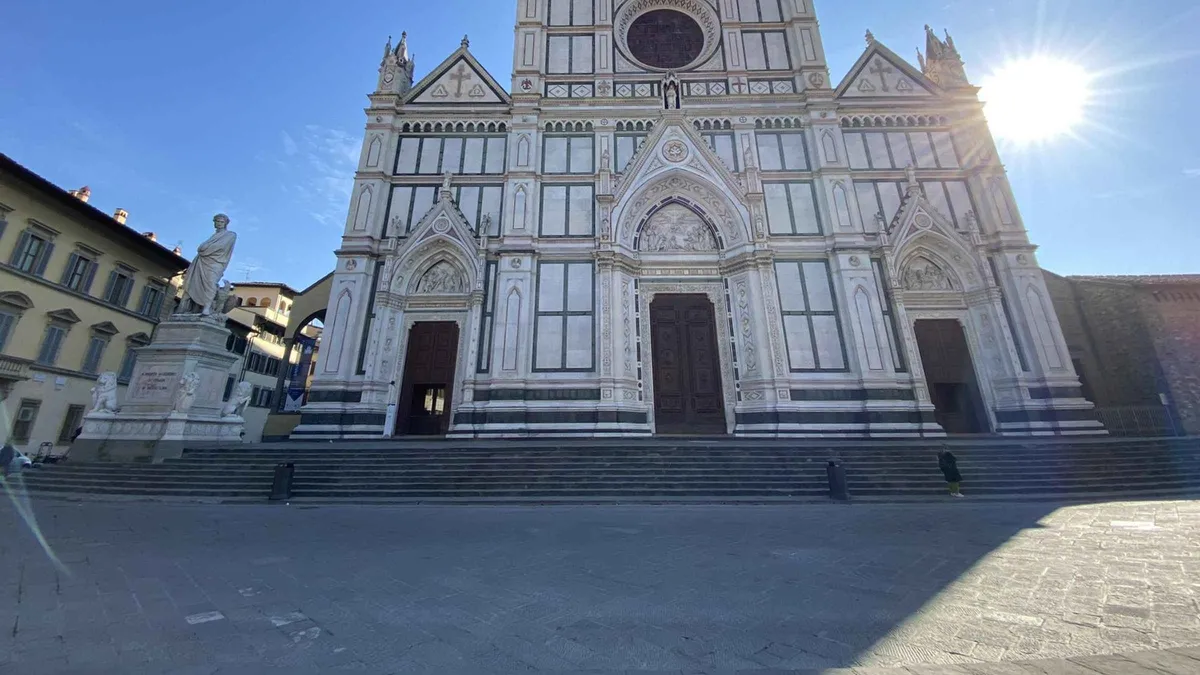
Florence: 1.5-hour Santa Croce Guided Experience
listed at $41.61
90-minute guided Santa Croce visit with fast-track ticket; Giotto frescoes, Galileo and Michelangelo tombs. English, Spanish or Italian.
Check Availability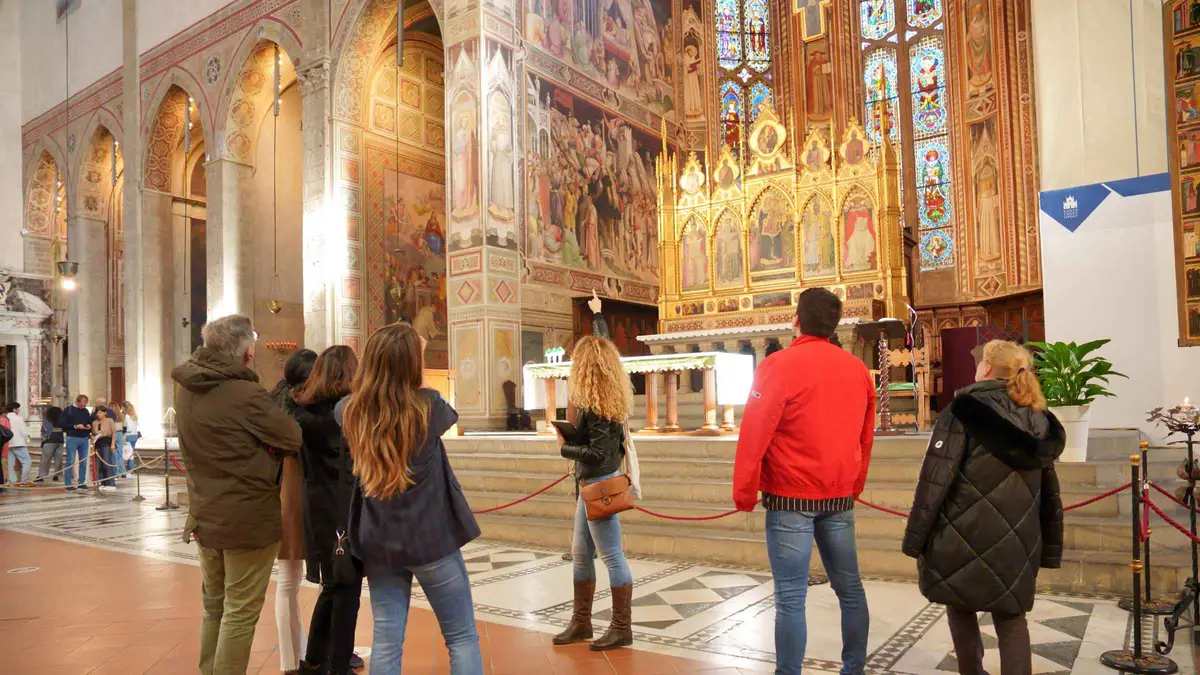 from €48
Florence: Santa Croce Church Tour with Entry Ticket
listed at $55.60
One-hour Santa Croce tour with reserved entry ticket and radio headsets; four guide languages. Wine-and-appetizer option on some dates.
Check Availability from €55
Florence Cathedral, Baptistery & Duomo Museum Guided Tour
listed at $63.94
Cathedral, Baptistery and Duomo Museum with a live expert plus 13-language audio guide; bell tower and dome climbs sold as options. Separate entrance.
Check AvailabilityFigures current in Q3 2026.
Prices, ratings and details are the platform's own. Dollar figures are the listed prices. The platform bills in your account's currency.
Questions about the flood and its traces
How high did the water get in Florence in 1966?
The highest plaque in the historic centre reads 4.92 metres, at Via San Remigio by Via dei Neri, seventy centimetres above the 1333 mark on the same wall. Around Piazza Santa Croce the plaques read 4.40 metres, and at the Duomo between 1.50 and 2.00. The Uffizi separately describes six metres at Santa Croce as a district figure, which does not agree with the plaques; both are institutional and neither is averaged here.
How many people died in the 1966 flood?
There is no single answer, and the contemporary official counts range from 33 to 37 depending on which ministry and which date you take. The Civil Protection Department publishes 34 in its own PDF and 35 on its own website. CNR-IRPI's research archive, counting deaths from consequences and rescue work as well, reconstructs 19 in the city of Florence, 38 in the province and 47 across Tuscany.
Can you still see flood marks in Florence?
Yes, and there are more than people expect. The Arno Basin Authority's catalogue records 153 plaques in the historic centre, of which 131 are from 1966, 12 from 1844, 4 from 1557, 3 from 1333, 2 from 1740 and 1 from 1547. The densest cluster is between Piazza Santa Croce and Via dei Neri; the churches guide covers the buildings several of them are fixed to.
Where is Cimabue's Crucifix now?
In the Sacristy of Santa Croce, where it was moved in 2013 as protection against a future flood. It lost sixty per cent of its painted surface in 1966 — the figure the Opera di Santa Croce and the Uffizi both state — and was restored over a decade after emergency treatment in the Limonaia at the Boboli Gardens. The Santa Croce page has the complex's hours and prices, and a guided visit covers the basilica and its cloisters.
Are the Baptistery doors the originals?
No. What hangs on the Baptistery today is a copy fitted in 1990. Ghiberti's originals, whose panels were torn from the frame by the flood, are displayed in the Museo dell'Opera del Duomo, reassembled inside a sealed case filled with inert nitrogen. Accounts differ on whether five or six of the ten panels came away, and no institutional page we could read settles it. The cathedral museum page covers what else is in that hall.
Is there a museum of the 1966 flood in Florence?
There is not. The Museo di Firenze com'era, which visitors still search for, closed permanently in 2010 and its collections were split between Palazzo Vecchio and Villa La Petraia. For the sixtieth anniversary the Archivio di Stato has announced an exhibition from 4 November 2026 to 6 February 2027, free with reservation, and the Comune has announced a programme at Palazzo Vecchio whose dates were not yet published when this page was written. The events calendar tracks what is confirmed.
The Flood on Film, and the City Sixty Years After
Three accounts of the same November: the streets then and now, an eyewitness who was in the city that night, and a reconstruction of what the river did in the twelve hours after it came over the banks.
Florence 1966 and Today: A Then and Now Look at the Flood
Archive footage matched to the same corners as they look now, including several of the streets that carry the plaques.
Video: Souls of ItalyCaught Out in the Florence Floods: Surviving 1966
A first-hand account from someone who was in the city on the night the Arno came over, which is what the numbers cannot give you.
Video: Souls of ItalyFlorence Flood 1966: The Day a Renaissance Went Underwater
A narrative reconstruction of the twelve hours from the first overflow to the second peak, useful before you go looking for the marks.
Video: Retold in MotionVideos load from YouTube only when you press play.