 Florence City Guide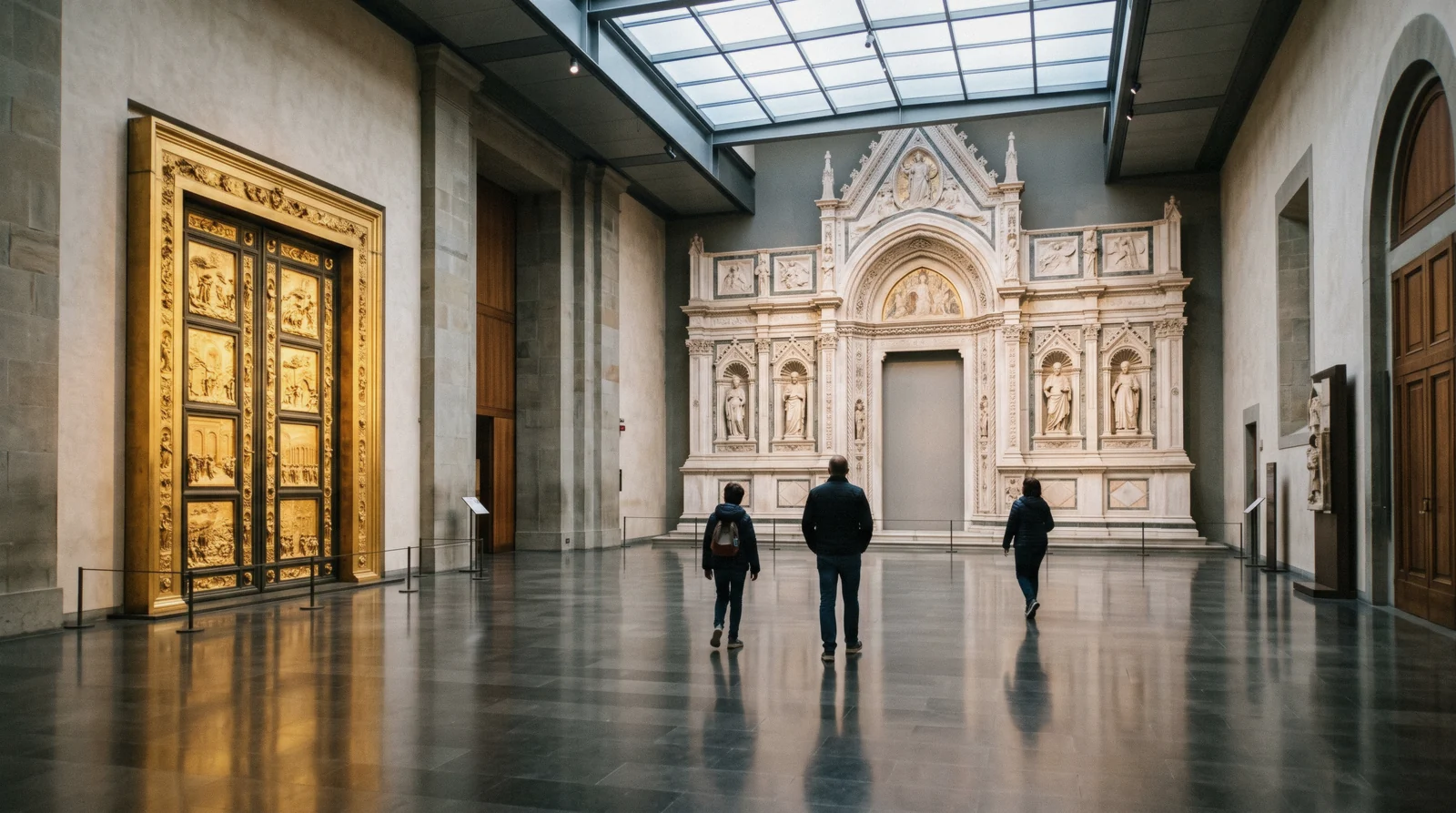
Opera del Duomo Museum
The Opera del Duomo Museum, at Piazza del Duomo 9, holds the originals that were taken off the cathedral, the Baptistery and the bell tower and replaced outside with copies: all three sets of Baptistery bronze doors including Ghiberti's Gates of Paradise, Donatello's Penitent Magdalene and Zuccone, both marble singing galleries and Michelangelo's last Pietà. It is the least crowded and the most rewarding room in the complex, and it is the one monument here that has no ticket of its own — the three Duomo passes are the only way in. This page covers what is inside, the hours, the entrance and how the pass logic works for a visitor who does not want to climb anything. Hours, prices and rules come from the Opera's own ticket portal, like the rest of the best things to do in Florence covered on FlorenceCityGuide.com.
Quick answer What is inside, how you get in, hours — in three lines
The museum keeps the originals removed from the cathedral, the Baptistery and the bell tower, and is open daily 08:30–19:00 except the first Tuesday of each month. There is no museum-only ticket: it comes inside a complex pass, such as the dome climb ticket with the 3-day pass.
Key takeaways
- Ghiberti's Gates of Paradise, Donatello's Magdalene and Michelangelo's late Pietà stand under a full-size rebuild of the cathedral front that was pulled down in 1587 — the Opera allows 60 to 90 minutes and that is honest
- The dome climb ticket with the 3-day complex pass at €53 (about $62) includes the museum, the Baptistery, Santa Reparata and the tower. If you would rather not climb, the guided cathedral, Baptistery and museum tour at €55 covers the museum with a live expert, and how the passes work covers the rest
- Start with the cathedral itself, whose nave is free Monday to Saturday 10:15–15:45, then come here — the museum stands opposite the apse, one minute round the building
Key facts
Opening hours
| Daily, all year | 08:30–19:00 |
|---|
Closed First Tuesday of each month; Easter Sunday, 25 December and 1 January, when the whole complex closes
Admission
- Adult
- No single ticket. €53 dome climb with the 3-day complex pass (about $62), or €55 guided cathedral, Baptistery and museum tour (about $64)
- Reduced
- Reduced rates for ages 7–14, and for students of any age with a card
- Free
- Ages 0–6; disabled visitors and a companion; clergy; ICOM members for the museum only
Planning it
- Time needed
- 60–90 minutes (the Opera's own figure)
- Book ahead
- Recommended — a few days
- Address
- Piazza del Duomo 9, 50122 Firenze — facing the apse, the east end of the cathedral; ticket office at Piazza San Giovanni 7, Monday–Saturday 08:00–19:15, Sunday 10:15–17:45
Three ways into this museum from the cards on this page, at the prices GetYourGuide lists. The Opera sells no museum-only ticket, so each one carries the museum inside a wider pass or tour.
The museum has no ticket of its own, so the question is which ticket carries you into it.
| Option | Price | Includes | Slot booked at | Book |
|---|---|---|---|---|
| Cupola entry with the 3-day complex passAnyone climbing the dome, with the museum included for three days | €53 (about $62) | Reserved climb slot, museum, Baptistery, crypt, tower, audio app | The cupola | Check Availability |
| Guided cathedral, Baptistery and museum tourVisitors who want the museum explained without climbing anything | €55 (about $64) | Live expert guide, 13-language audio guide, cathedral, Baptistery, museum | Your tour start time | Check Availability |
| Guided visit including this museumVisitors who want the Bandini Pietà and the cantorie explained | From €119 | Licensed guide inside the museum, climb slot, 72-hour complex pass | The cupola | Check Availability |
The last column is the monument or start time you have to book, because the museum has no slot of its own. A complex pass runs for three calendar days and admits you once to each monument, so the museum can be your indoor hour on any of them. Figures current in Q3 2026.
Getting into the Opera del Duomo Museum
Five products on the platforms we track include this museum. Each links to the seller's own page, where the calendar shows the slots still open.
 from €53
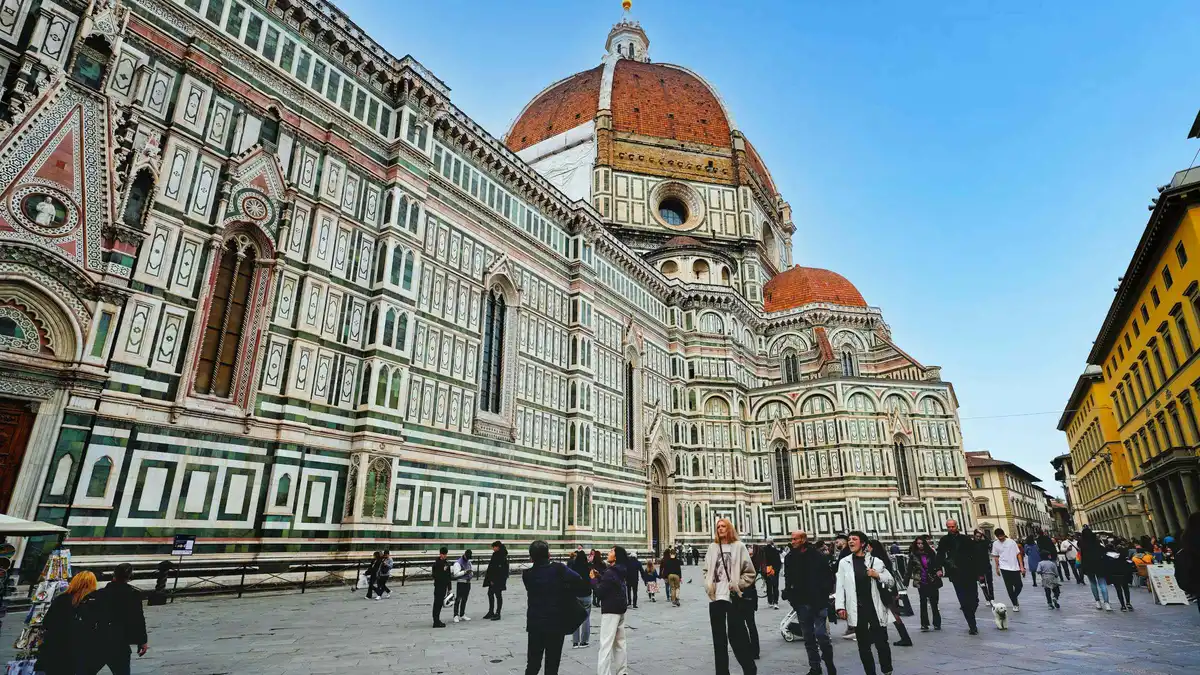
Florence: Brunelleschi's Dome Climb Entry Ticket & Duomo
listed at $61.77
Timed dome-climb ticket plus a 3-day Duomo complex pass (cathedral, baptistery, museum, crypt, bell tower) and an audio app. 463 steps, no lift.
Check Availability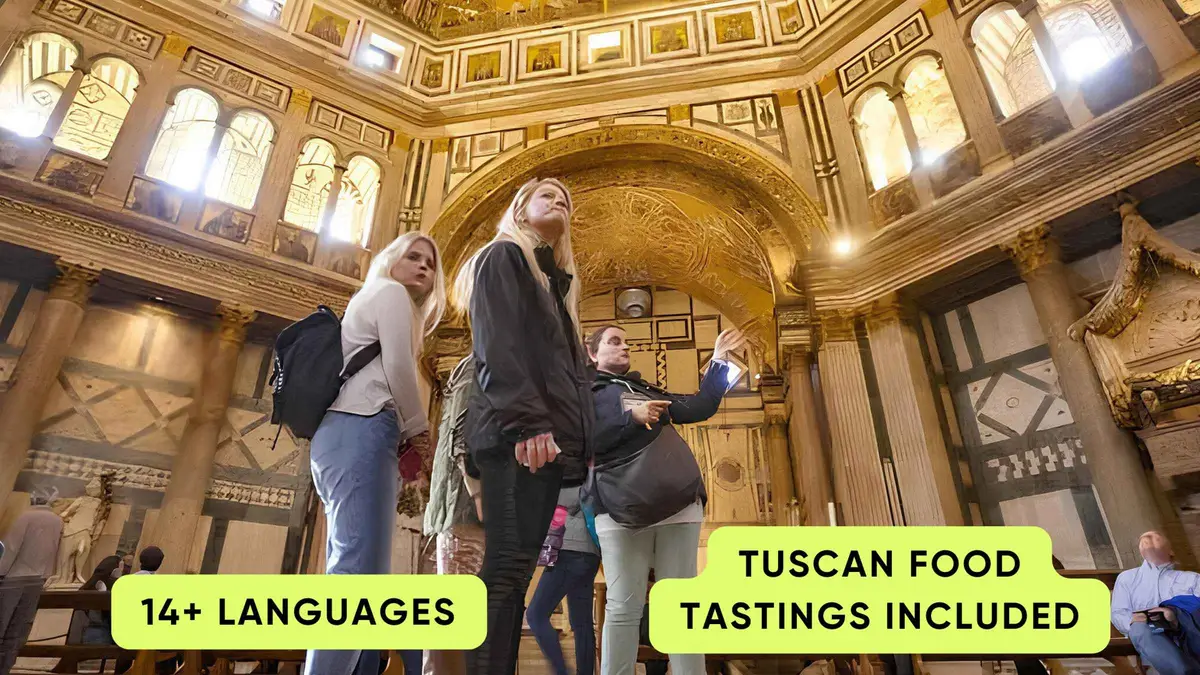 from €55
Florence Cathedral, Baptistery & Duomo Museum Guided Tour
listed at $63.94
Cathedral, Baptistery and Duomo Museum with a live expert plus 13-language audio guide; bell tower and dome climbs sold as options. Separate entrance.
Check Availability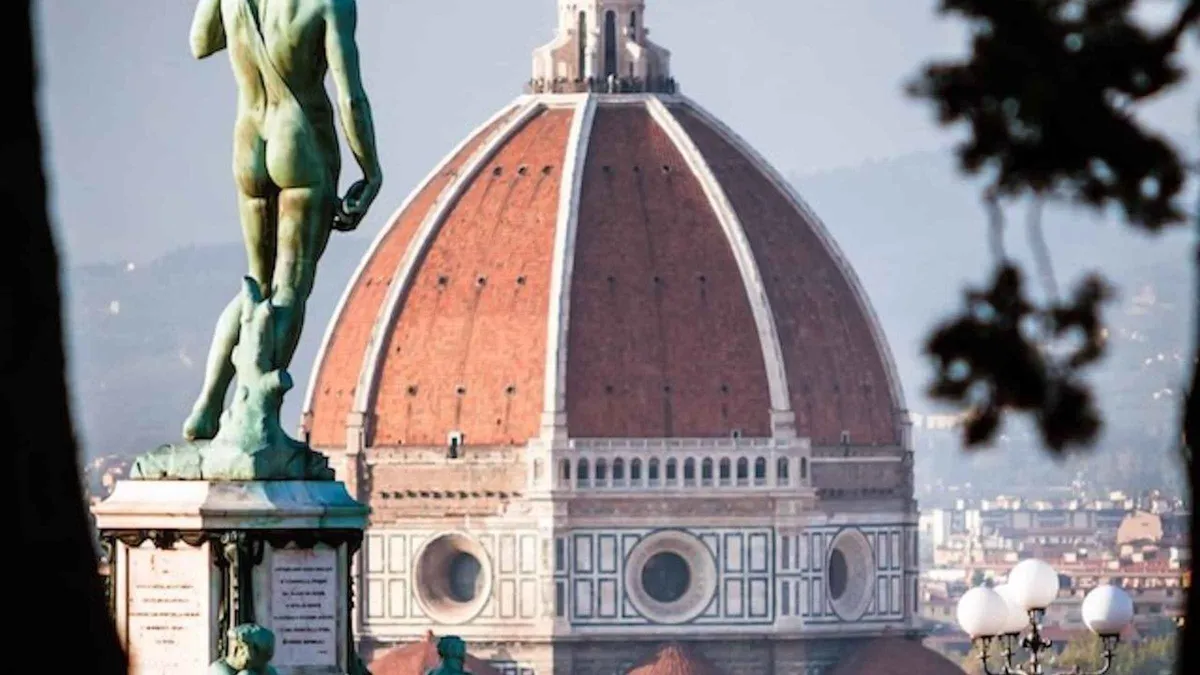 from €119
Florence Duomo with Dome Climb Tickets and Museum Tour
listed at $139
Small-group dome climb with a guide, a tour of the Opera del Duomo Museum and a 72-hour pass for the rest of the complex. English only.
Check Availability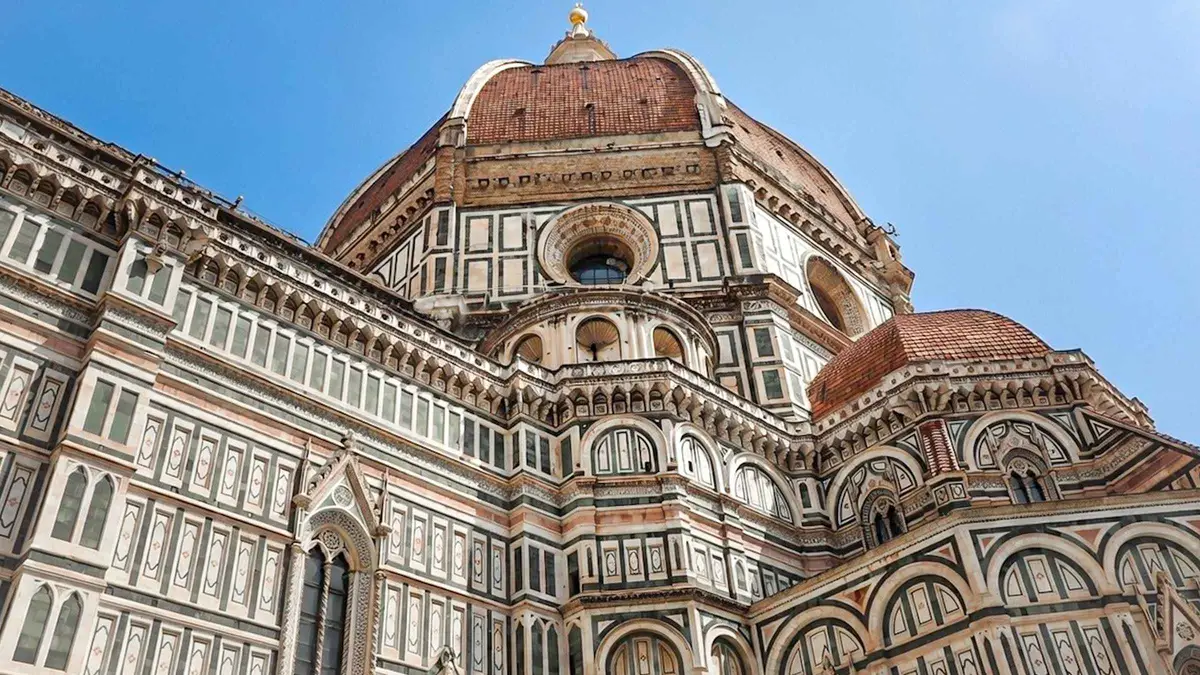 from €53
Florence: Climb Brunelleschi's Dome Ticket & Duomo Pass
listed at $62.09
Fixed-time Brunelleschi dome climb and a 3-calendar-day pass to the whole Duomo complex, delivered as digital tickets with an audio app.
Check Availability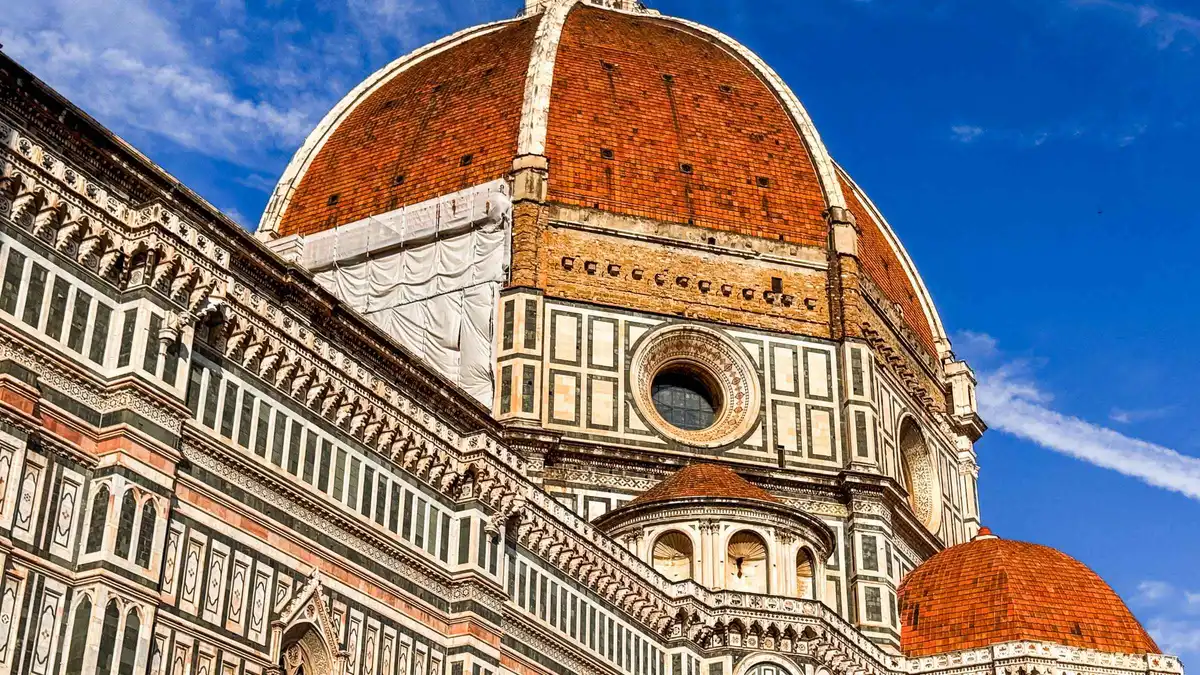 from €99
Florence: Guided Duomo & Brunelleschi Dome Climb
listed at $115.72
Two-hour guided tour of the baptistery, museum and cathedral exterior, then the 463-step dome climb; 3-day pass covers the interior, crypt and tower.
Check AvailabilityPrices, ratings and details are the platform's own. Dollar figures are the listed prices. The platform bills in your account's currency.
What it is: the cathedral's own storeroom of originals, since 1891
The Opera di Santa Maria del Fiore has run the cathedral's building works since 1296. The museum is what happens when an institution that old keeps everything it ever took down.
The workshop yard where the sculpture was made
This site is not a gallery that acquired a collection; it is the yard where the works were carved. The Opera commissioned the sculpture for the cathedral, the Baptistery and the bell tower, employed the sculptors, and stored what came off the buildings. David was commissioned here as one of a series of buttress figures for the cathedral, carved from a block the Opera already owned and had already had two other sculptors fail on; the finished statue went to Palazzo della Signoria instead and now stands at the Accademia.
The trace of that history is why the museum feels like a workshop rather than a display.
Opened as a museum in 1891: copies outside, originals inside
The museum opened in 1891, at a point when the effects of weather and pollution on outdoor marble and bronze were finally understood. The principle has not changed since: the object on the building is a copy, the original is in here. That applies to all three sets of Baptistery doors, to Donatello's prophets from the bell tower, and to a great deal of what visitors photograph outside without realising they are photographing a replacement.
2009–2015: the Teatro Nuovo and the façade rebuilt at full scale
Between 2009 and 2015 the Opera annexed the neighbouring Teatro Nuovo and rebuilt the museum around it, which produced the Sala del Paradiso — a hall high enough to hold a full-scale reconstruction of Arnolfo di Cambio's cathedral front, demolished in 1587, with the surviving statues set back in the positions they occupied on it. The museum now holds over 750 works spanning 720 years, and has been directed by Fr Timothy Verdon since 2011. If you visited before 2015, you have not seen this building.
One note for anyone cross-checking records rather than streets: the museum is Wikidata Q1200696 while the Opera that runs it is Q28466087 — two separate entries at one address, which is why search results sometimes merge the museum with its institution.
What to see: room by room
No official floor plan is published on the pages we could fetch, so the sections below name the rooms rather than numbering them. The route runs upward: the great hall first, then the Pietà on the stairs, then the upper floors.
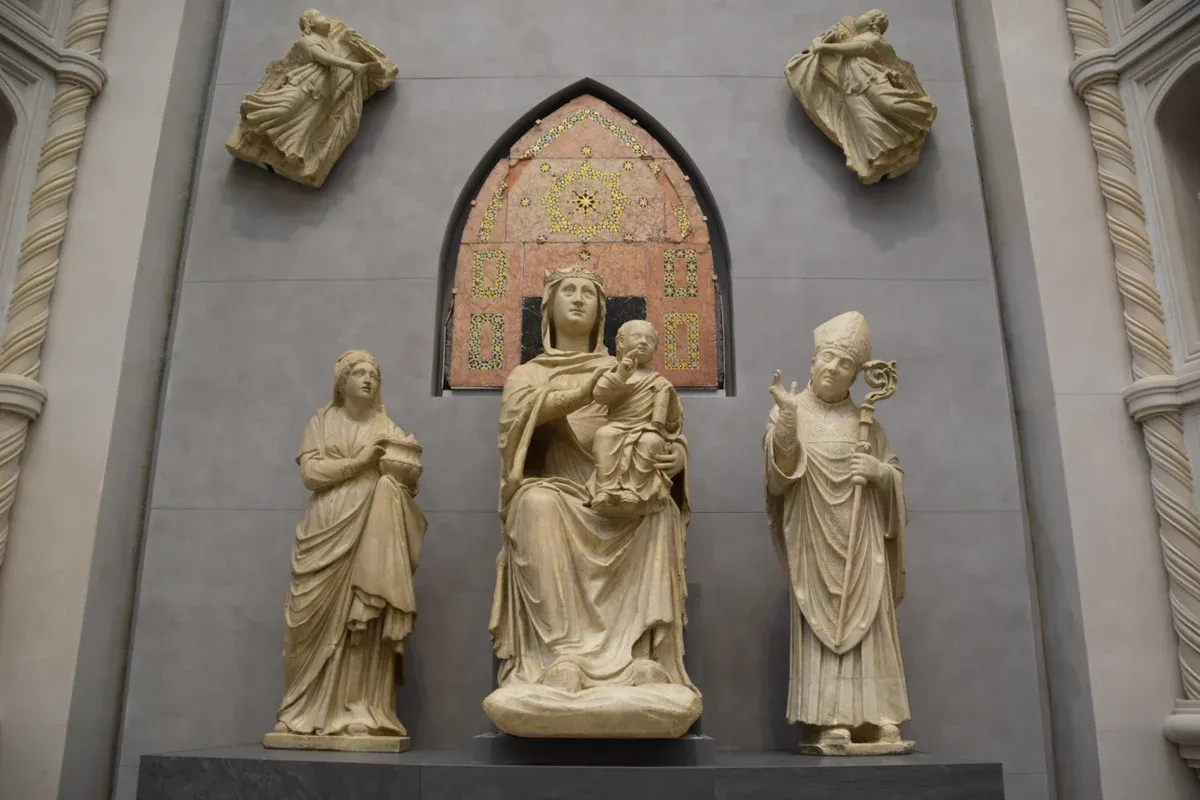
Photo: George M. Groutas, CC BY 2.0, via Wikimedia Commons (https://creativecommons.org/licenses/by/2.0)
The Sala del Paradiso and all three sets of bronze doors
You walk into a hall facing a wall that is the medieval cathedral front rebuilt at full size, with Arnolfo di Cambio's sculptures back in their niches, including the Madonna with the Glass Eyes of about 1300–1310 — the glass paste in her eyes is the detail everyone leans in for. Behind you, on the opposite wall, are the three original sets of Baptistery doors: Andrea Pisano's south doors of the 1330s, Ghiberti's north doors, and the Gates of Paradise, the ten gilded panels Michelangelo is said to have named. All three are restored and behind glass in a climate-controlled setting; the doors on the Baptistery itself are copies.
The room is designed so you stand between the façade and the doors as if in the square that no longer exists. It is worth doing what almost nobody does and sitting on the bench in the middle for five minutes.
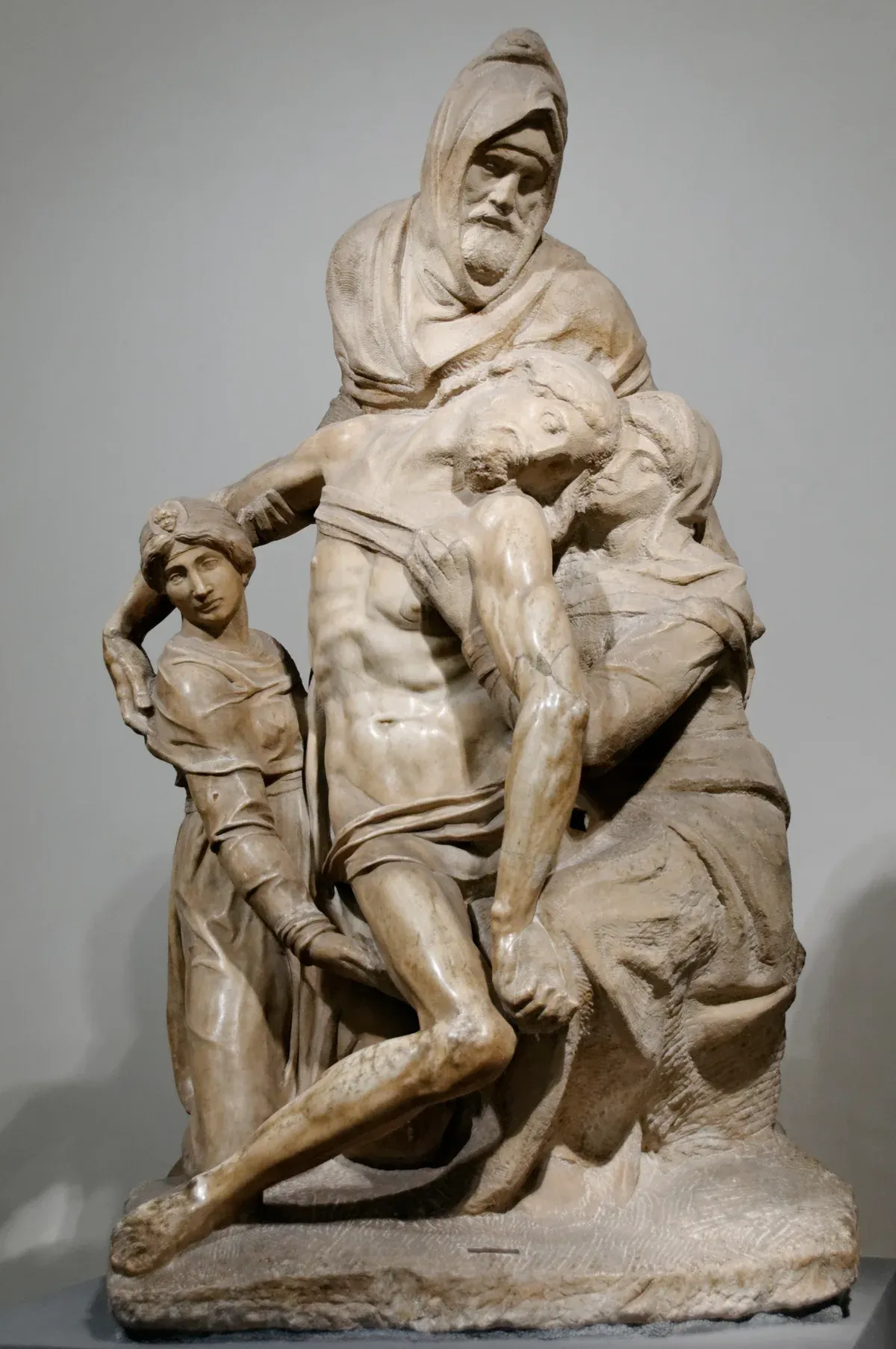
Photo: Marie-Lan Nguyen, CC BY 2.5, via Wikimedia Commons (https://creativecommons.org/licenses/by/2.5)
Michelangelo's Pietà — the Bandini group, begun about 1547
On the mezzanine stands the Pietà Michelangelo began for his own tomb in about 1547, worked on for some nine years, and then attacked with a hammer and abandoned; a pupil partly repaired it and Christ's left leg is missing entirely. The hooded figure of Nicodemus holding the body is a self-portrait, made in his seventies. Tool marks are left raw across the surface.
This is not the Pietà in St Peter's, and the difference between the two — one polished at twenty-four, one broken at seventy — is the whole argument for coming here.
Donatello's Penitent Magdalene
The Magdalene is carved in white poplar, originally in the Baptistery, and shows an old woman in rags of her own hair with her hands almost meeting in front of her. Vasari described her as wasted by fasting until every part of the body showed a complete understanding of anatomy. Nothing like her had been made before, a saint shown gaunt and old instead of young and beautiful.
Scholars long dated her to Donatello's last years, around 1453-1455, and now place her earlier, in the late 1430s. The Arno flood of 1966 damaged her, and the restoration brought back traces of the original paint and gilding, still visible on the hair. She is lit low and set at eye level, and she empties the room around her.
The two cantorie: Luca della Robbia and Donatello
The singing galleries that once stood over the cathedral sacristy doors face each other in one room: Luca della Robbia's, carved with children singing from clear, closely observed panels, and Donatello's, a blur of putti running behind a screen of columns. They were made within a few years of each other for the same building by two men solving the same commission in opposite ways, which makes this the best-arranged room in the museum.
Upstairs: the Zuccone and the bell-tower originals
The prophets carved for the niches of Giotto's campanile are on the upper floor, where the originals were brought in from the weather and replaced on the tower by copies. Donatello's Habakkuk is among them, the bald, gaunt figure Florentines nicknamed the Zuccone, the pumpkin, carved between 1423 and 1425. It was reportedly his favourite.
He is supposed to have sworn "by the faith I place in my Zuccone" and to have shouted at the marble to speak while he carved it. Vasari thought the face was a portrait of a real Florentine rather than a prophet. Nanni di Banco and Lamberti carved the others.
Seeing them at eye level rather than from the square forty metres below is the point of the room.
The Reliquary Chapel, the Galleria dei Modelli and the choir reliefs
The Reliquary Chapel is an octagon holding over 600 relics in their goldsmith's cases, with a recorded choir running under it. The Galleria dei Modelli on the upper floor holds the wooden models submitted to the nineteenth-century competition to finish the cathedral front, including Emilio De Fabris's winning design from the 1870s — the façade that is out there now. Baccio Bandinelli's marble choir reliefs, carved between 1547 and 1572, the vestments and the silver altar of the Baptistery fill the remaining rooms.
Hours and the first-Tuesday closure
The museum opens every day from 08:30 to 19:00 and closes on the first Tuesday of each month — the single scheduling trap on this site, because nothing else in the complex closes that day and a pass bought for a first Tuesday will not get you in here. The whole complex closes on Easter Sunday, 25 December and 1 January.
A pass is valid for three calendar days counted from the date of its first monument, and it admits you once to each. So the museum can be done on any of the three days at any hour it is open, which makes it the natural filler for a wet afternoon or the hour before dinner.
Two things in 2026 change which pass is worth buying. The cupola is closed for maintenance from 16 to 20 November and the tower from 9 to 13 November; the tower is also under restoration with its views partly reduced, and the Baptistery vault mosaics are under restoration and not visible. If those were your reasons for climbing, the guided cathedral, Baptistery and museum tour keeps you at ground level, and the pass comparison has the full picture. For anyone reworking a Duomo day around those closures, other Florence guided tours can fill the time the tower and cupola would have taken.
- Open daily 08:30–19:00; closed the first Tuesday of each month
- Complex closed Easter Sunday, 25 December, 1 January
- Pass valid 3 calendar days from the first monument; one entry per monument
- The Opera's own estimate for this museum: 60–90 minutes
Inside: the OperaGuide app, what to wear, and bags
The Opera publishes a free official app, OperaGuide, with audio commentary in Italian and English; the price of a rental audio guide is not stated on the pages we fetched. Download it on the hotel wifi rather than in the square.
On clothing: the rule about covered shoulders, knees and no flip-flops applies to the cathedral and the Baptistery, and the Opera's own portal says it 'does not apply to the other monuments in the complex' — that is, not here. Since every complex pass pairs this museum with the Baptistery, dress for the Baptistery and you are covered for both.
Luggage cannot be brought into the complex and must go to the storage at Piazza Duomo 38/r. Whether the museum itself has a cloakroom, a lift, or a policy on photography is not stated on the pages we fetched, so we say nothing about them rather than guess. Under-18s cannot climb the cupola or the tower without an adult, which does not affect the museum but does affect the pass a family should buy.
- Free OperaGuide app, audio in Italian and English
- No dress code in the museum; the cathedral and Baptistery rule still applies to those
- Luggage to the storage at Piazza Duomo 38/r
- Cloakroom, lift and photography rules: not stated on the official pages
How to get there and where the entrance is
The entrance is at Piazza del Duomo 9, on the far side of the square from the Baptistery, directly facing the apse — the rounded east end of the cathedral. From the Baptistery it is one minute round the building, and almost everyone walks past it because the front is discreet and the crowd is looking the other way. The ticket office is not here but at Piazza San Giovanni 7, open Monday to Saturday 08:00–19:15 and Sunday 10:15–17:45.
From Santa Maria Novella station it is a ten-minute walk down Via de' Panzani and Via de' Cerretani. Buses C1 and C2 serve the centre; an urban bus or tram single is €2 (about $2.30) and lasts 90 minutes under the fares in force from 1 August 2026. The square is inside the ZTL and there is nowhere to park — getting around Florence covers the buses and the camera gates.
One disambiguation: the Museo dell'Opera del Duomo in Pisa is a different museum, on the Campo dei Miracoli, an hour away by train.
- Entrance: Piazza del Duomo 9, opposite the apse
- Ticket office: Piazza San Giovanni 7, Monday–Saturday 08:00–19:15, Sunday 10:15–17:45
- 10 minutes on foot from Santa Maria Novella station; urban single €2, 90 minutes
- Not the museum of the same name in Pisa
Opera del Duomo Museum map: the door, the desk and the storage
The museum entrance, the ticket office it is not attached to, and the rest of the complex within two minutes.
Next stop from the Opera del Duomo Museum
Walk minutes are our estimates from the GPS distances; the first one is across the road.
The cathedral and the rest of the complex
The nave is free Monday to Saturday 10:15–15:45 and closed to visitors on Sundays; everything else in the complex is on the same pass you already hold. The Duomo page has the dress code and the climb rules.
1 min walkBargello
Reserved entry €19 (about $22), Tuesday to Sunday. The Bargello holds the two 1401 competition panels by Ghiberti and Brunelleschi that led to the doors you have just seen.
4 min walkSan Lorenzo
€9 (about $11), Monday to Saturday 10:00–17:30, closed Sundays. San Lorenzo is Brunelleschi's other Florence — the nave, the Old Sacristy and Donatello's last bronze pulpits.
5 min walkOpera del Duomo Museum questions
Can I buy a ticket for the Opera del Duomo Museum only?
No. The Opera sells no single-monument ticket, so the museum comes inside a complex pass. The dome climb ticket with the 3-day pass at €53 (about $62) includes it, and the guided cathedral, Baptistery and museum tour at €55 (about $64) takes you through it with a guide. How the passes work sets out the rest.
Are the real Gates of Paradise in the Opera del Duomo Museum?
Yes. All three original sets of Baptistery bronze doors are here — Andrea Pisano's south doors, Ghiberti's north doors and the Gates of Paradise — restored and displayed behind glass in the Sala del Paradiso. The doors mounted on the Baptistery outside are copies. The two 1401 competition panels that started the whole story are a four-minute walk away at the Bargello.
Is Michelangelo's Pietà in the Opera del Duomo Museum?
The Bandini Pietà is, on the mezzanine: begun about 1547 for his own tomb, worked on for some nine years, damaged by Michelangelo himself and left unfinished, with Nicodemus as a self-portrait. The polished Pietà of his twenties is in St Peter's in Rome, and his David is at the Accademia.
Is there a dress code for the Opera del Duomo Museum?
Not for the museum. The Opera's ticket portal applies the rule on covered shoulders, covered knees and no flip-flops to the cathedral and the Baptistery, and states that it 'does not apply to the other monuments in the complex'. Since the same pass usually covers the Baptistery, dress for that and you are fine everywhere — the Duomo page has the full wording.
When is the Opera del Duomo Museum closed?
The first Tuesday of every month, which catches people out because nothing else in the complex closes that day. The whole complex also closes on Easter Sunday, 25 December and 1 January. Otherwise it is open daily 08:30–19:00, including Sundays, when the cathedral nave itself is shut to visitors.
How long do you need at the Opera del Duomo Museum?
The Opera's own figure is 60 to 90 minutes, and it is realistic: the Sala del Paradiso, the Pietà, the Magdalene, the two cantorie and the campanile prophets fill an hour without hurrying. Add about 30 minutes if you take the Baptistery on the same pass. The two-day Florence plan puts both into one afternoon.
Does the 72-hour city pass cover this museum?
No. The Duomo complex is absent from every Firenzecard museum listing, so none of the three passes is included and the card does not get you in here. The Firenzecard page has what the card does cover and when it pays for itself.
Which ticket should I buy if I do not want to climb anything?
The guided cathedral, Baptistery and museum tour at €55 (about $64): the museum, the cathedral and the Baptistery with a live expert. It skips the 463 steps of the cupola and the 414 of the tower entirely, and in 2026 the tower is under restoration with reduced views anyway. The pass comparison shows what the climbing tickets add.
Where this museum fits in a Florence day
Treat it as the indoor hour that the rest of the complex does not give you. A pass runs for three calendar days, so the sensible arrangement is a climb or the Baptistery early on day one, the free cathedral nave when the queue drops after 15:00, and this museum on whichever afternoon turns wet — as long as it is not the first Tuesday of the month.
It also changes what you see everywhere else. Once you have stood in front of the real doors, the copies on the Baptistery read differently, and so do the prophets on the campanile and the statues on the front. Every Florence museum with hours and prices sits in one table, the full attractions list ranks the rest by time needed, and Orsanmichele and the churches picks up the other buildings that sent their originals indoors; the rest of this guide starts from places to visit in Florence.
The Opera del Duomo Museum on video
Three films covering the rooms described above — the great hall, the Pietà and the layout of the rebuilt museum — before you decide which pass to buy.
Museo dell'Opera del Duomo — Florence Museums — virtual walking tour, 4K
A full walkthrough at museum pace, useful for judging how the Sala del Paradiso and the upper floors are laid out.
Video: Shaky PicturesOpera del Duomo Museum: The Three Pietàs of Michelangelo exhibition
The Bandini Pietà set beside casts of the other two, filmed in the museum by a Florence English-language paper.
Video: The FlorentineThe Museo dell'Opera del Duomo — Florence Italy
A visitor's run through the doors, the cantorie and the campanile prophets, at the length this page recommends.
Video: Eric Clark's Travel VideosVideos are third-party and were not filmed by us; hours and prices in them may predate the figures on this page.
Prices, hours and terms are set by the venue or operator and confirmed at checkout.
We may earn a commission if you book through one of our links, at no extra cost to you. Full affiliate disclosure