 Florence City Guide
Uffizi vs Accademia: Which One If You Only Do One
Uffizi vs Accademia is the first real decision most people make about a short stay and what to see in Florence: two state museums, closed on the same day, and completely unlike each other inside. One is a forty-five-room painting gallery you walk for two hours. The other is one hall built around one statue, and most visitors are back on the street inside an hour. This page sets the two side by side on what each holds, how long each takes, what the entry rules actually are, and who should book which. Prices below are for the reserved-entry tickets listed for each museum, and dollar figures are approximations at €1 = $1.17.
Quick answer The verdict, the two prices, and the hour each one really takes
If you can only do one, do the Uffizi. It is the larger collection by a wide margin, it holds Botticelli's Birth of Venus and Primavera, and it rewards the two hours it asks for. The Accademia is a shorter, sharper visit built around Michelangelo's David, and it is the better choice if that statue is the reason you came, if you have children with you, or if you have ninety minutes rather than a morning.
Key takeaways
- Reserved entry to the Uffizi with an audioguide is €16 (about $19), and a timed entry to the Accademia with an audio app is €28 (about $33). Every way into both sits on the Florence ticket index
- Both are state museums, so both close on Mondays. The Monday and Sunday table shows what stays open instead
- The simplest way into each: a reserved-entry Uffizi ticket with audioguide or a timed David entry with an audio app
- Doing both in one day is a real plan, not a stretch. They are about a kilometre apart, and a combined timed pair at €30 (about $35) books the two entrances in one go
- Michelangelo's David is not in the Uffizi and never has been. The Piazza della Signoria one is a copy, and the Accademia page explains what else is in that hall
What each gallery actually holds
The Uffizi: a painting collection you walk through
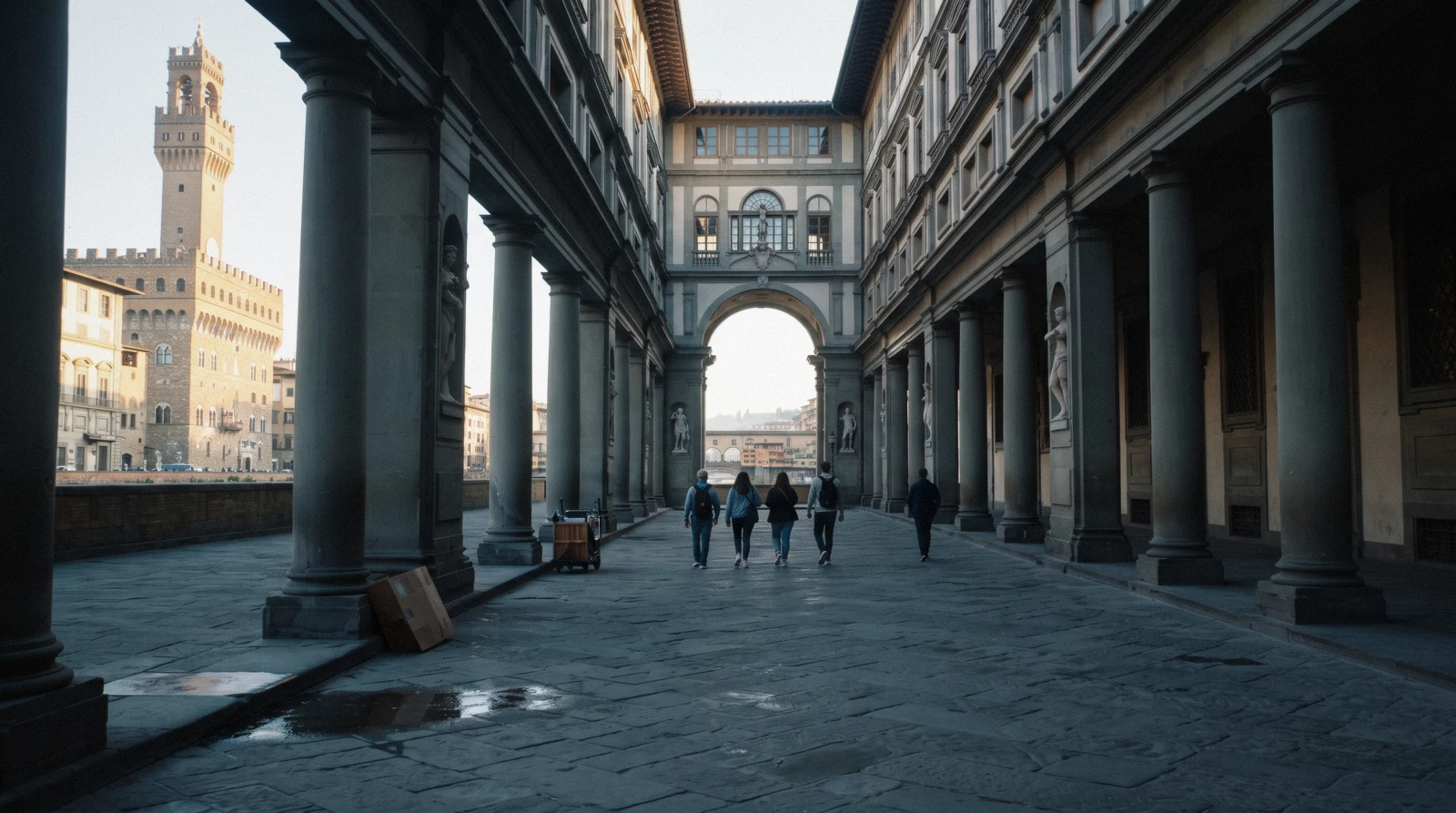
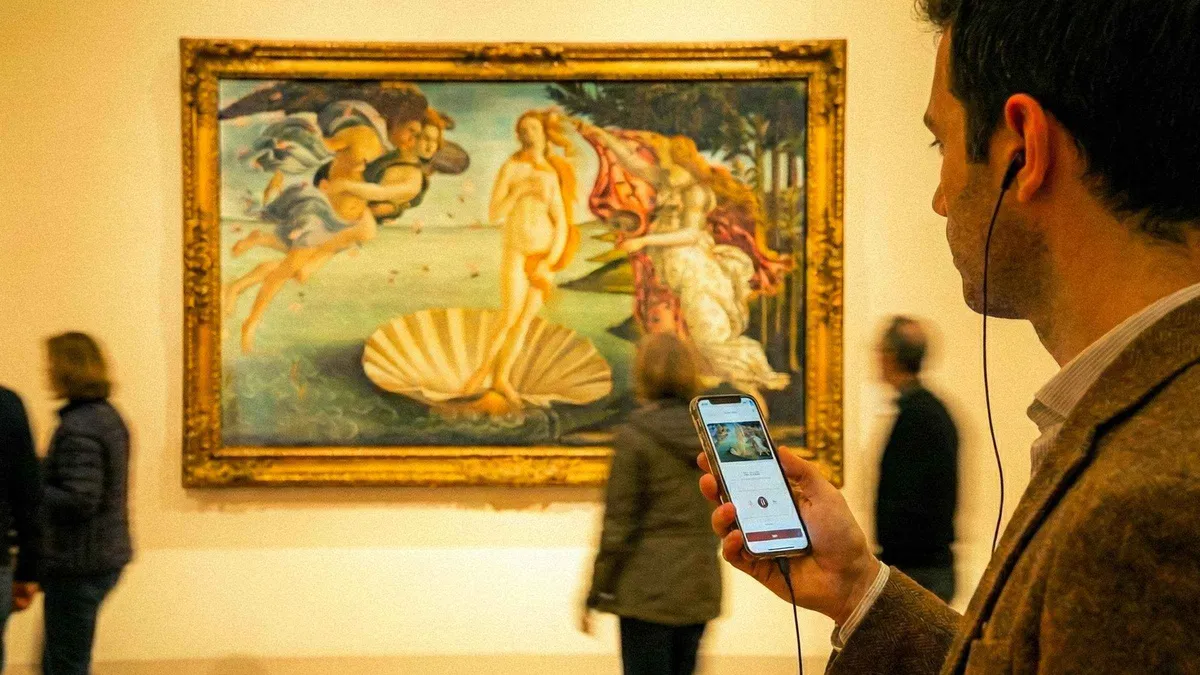
The Uffizi occupies Vasari's sixteenth-century office block beside the Arno, and the visit is a long U-shaped walk along two corridors and through the rooms that open off them. It is a painting gallery first: Botticelli's Birth of Venus and Primavera in the same room, Leonardo's Annunciation, Titian's Venus of Urbino, Caravaggio's Medusa, and a first floor that most people run out of energy before reaching. The building itself is part of the visit. The corridor windows frame the Arno, and the terrace café at the end looks straight at Palazzo Vecchio.
The practical consequence of all that is simple: the Uffizi is a place you can spend four hours in and a place you can do in ninety minutes, and both are legitimate visits. The museum does not publish a recommended visit length. Our routing, walking it as a first-timer would, puts the highlight run at about two hours.
The Accademia: one statue, and the room built for it
The Galleria dell'Accademia was founded as a teaching collection and is now, in practice, the building that houses David. Michelangelo's statue has stood under its purpose-built dome since 1873, at the end of a corridor lined with his unfinished Prisoners, four figures still half inside their blocks of marble, which are the reason the walk down that corridor is worth taking slowly rather than at speed.
Around it there is a hall of fifteenth-century Florentine panel paintings, a plaster-cast gallery of nineteenth-century sculpture models, and a museum of historical musical instruments from the Medici and Lorraine collections. None of that is why the queue exists. Be honest with yourself about which of those you will actually look at, because the answer decides whether the Accademia is an hour of your trip or twenty minutes.
The two galleries, line by line
The ticket rows show the reserved entries listed for each gallery: the Uffizi entry with audioguide and the timed David entry with audio app. Hours, closing days and free-entry rules come from each museum's own site, uffizi.it for the Uffizi and galleriaaccademiafirenze.it for the Accademia.
| Uffizi Gallery | Accademia Gallery | |
|---|---|---|
| Adult ticket | €16 (about $19), reserved entry with audioguide | €28 (about $33), timed entry with audio app |
| Reduced | Reduced fare for EU citizens aged 18 to 25 | Reduced fare for EU citizens aged 18 to 25 |
| Free | Under 18, any nationality, and the first Sunday of the month | Under 18, any nationality, and the first Sunday of the month |
| Hours | Tuesday to Sunday 08:15–18:30, ticket office closes 17:30 | Tuesday to Sunday 08:15–18:50, last admission 18:10 |
| Closed | Mondays, 1 January, 25 December | Mondays, 1 January, 25 December |
| Time needed | Not stated by the museum, our routing is about 2 hours | Not stated by the museum, our routing is about 1 hour |
The row readers get wrong most often is the last one: neither museum publishes a recommended visit length. Both galleries are state museums under the culture ministry, which is why their closed days match exactly.
How long each one really takes
Neither museum states a visit length, so what follows is our own routing, written down so you can argue with it rather than guess.
The Accademia is the predictable one. The corridor of Prisoners, the tribune with David, the panel-painting hall and the instrument rooms come to about an hour at an unhurried pace, and there is no realistic way to spend three hours there unless you are drawing. Families and anyone with a fixed lunch reservation can plan around that number with confidence.
The Uffizi is elastic in a way that catches people out. The gallery is arranged chronologically across two floors, and the rooms everyone has come for, Botticelli and Leonardo, arrive early, which means the natural stopping point is about halfway. A first-timer who walks the highlights and looks properly at ten or twelve paintings will be out in two hours. Someone who reads every label will not be out in four. The ticket office closing at 17:30 while the gallery closes at 18:30 is the museum quietly telling you that the last hour is for people already inside.
The practical planning number, if you want one: allow half a day for the Uffizi with a coffee in it, and allow ninety minutes for the Accademia including the wait to get in. That is the shape a one-day Florence plan is built around. For visitors who would rather hand the timing over to someone else, the same museums sit at the center of most Florence guided tours.
Getting in: the rules are not the same in the two buildings
Both museums sell dated, timed entry, and in both the ticket names the hour you may arrive rather than the hour you will be inside. Beyond that the systems diverge, and the difference is worth understanding before you spend money.
At the Uffizi, what a reserved ticket buys is a fixed slot on a date you have already committed to. In high summer that is worth a great deal, because the good morning hours do run out. A reserved entry with audioguide is €16 (about $19).
The Accademia wants a reservation, even for free entries
The Accademia works the other way. The museum takes reservations for free and reduced visitors as well, so a child who pays nothing to enter still goes in on a booked slot. The museum's own wording is that reservations are highly recommended and that without one "the wait for access may be long". That is as close as an Italian state museum comes to saying: turn up without a slot and you will stand on Via Ricasoli. A timed David entry is €28 (about $33).
One more Accademia rule that surprises people at the door: there is no cloakroom. Large bags, backpacks and helmets are refused, and bottles are limited to half a litre. If you are arriving straight off a train, deal with the luggage first. The station's left-luggage office is the answer, not the museum.
Free Sundays are free, and they are not a shortcut
Both galleries take part in the state museums' free first Sunday of the month. There is no reservation on those days and no advance ticket. Entry is issued at the door and the queue is the price.
If your visit falls on one of them, decide deliberately whether you are saving the fare or losing the morning. Details of which Florence sights that scheme covers, and the many it does not, are on the ticket index.
Which one, by the kind of trip you are having
If you have one day in Florence and have never been
the Uffizi, booked for the first slot of the morning. It is the bigger collection and the one you will regret skipping.
If David is the specific thing you came to see
the Accademia, and do not let anyone talk you into the Uffizi instead. The Uffizi does not have him.
If you are travelling with children under about twelve
the Accademia. One hour, one unmistakable object, and under-18s enter free at both museums.
If you have only a free afternoon
the Uffizi in a slot from 16:00, the quietest hour of the day. A reserved entry with audioguide is €16 (about $19), and the gallery stays open until 18:30.
If you want both and have one full day
the Accademia at opening and the Uffizi in the afternoon, or a combined timed pair that reserves both entrances at once.
If your only free day is a Monday
neither is open. The Monday guide has the day that works instead, built around the Duomo complex and the civic museums.
Ways into each gallery
Every card links to the operator's own page, where the live calendar shows which slots are still open. Prices are in euro, and the platform charges in your own currency at checkout.
 from €16
Florence: Uffizi Gallery Reserved Entry Ticket & Audioguide
listed at $18.53
Reserved timed Uffizi ticket with a downloadable audioguide app in 6 languages and unlimited time inside. Nominative ticket — bring matching ID.
Check Availability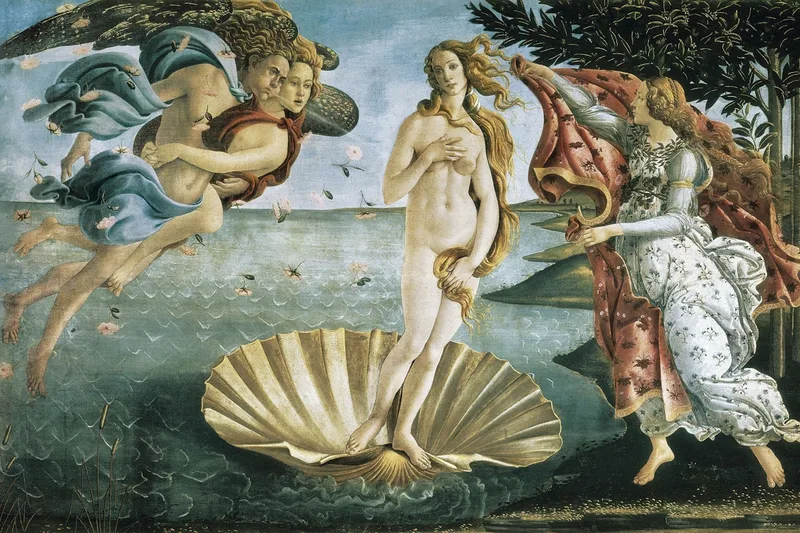 from €25.00
Uffizi Gallery: Reserved Entry + Audio Guide
Reserved Uffizi slot with a downloadable audio guide. Pick your entry time, show ID at the door. The ticket is nonrefundable.
Check Availability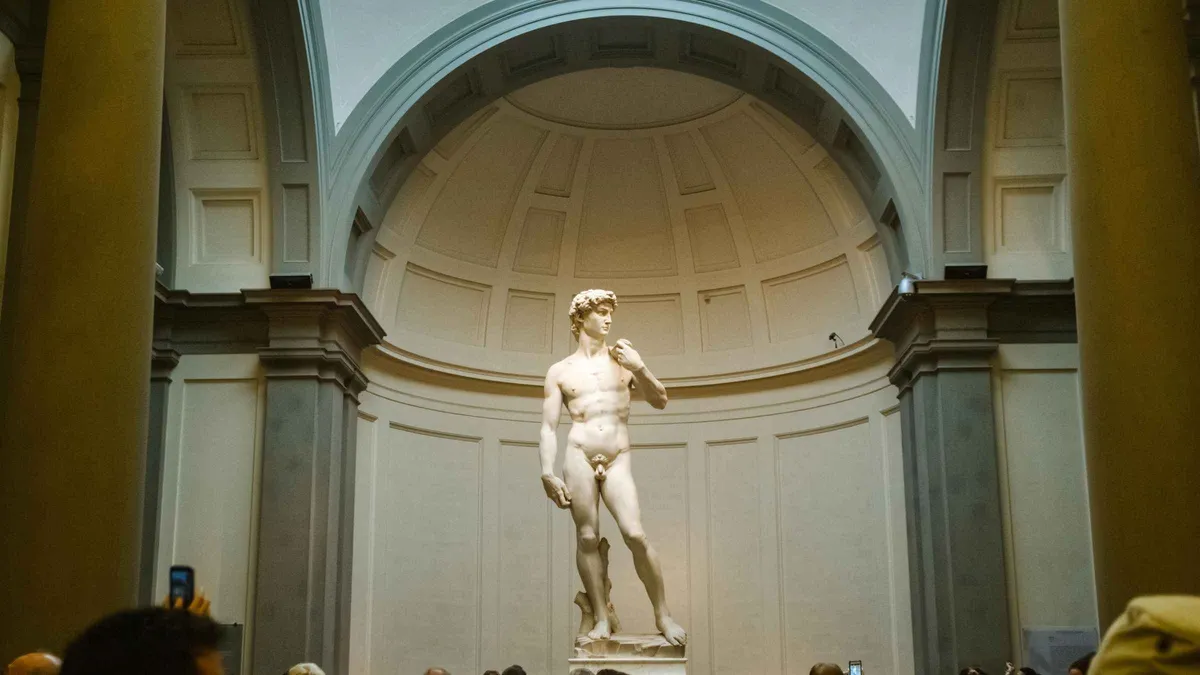 from €28
Best seller
from €28
Best seller
Florence: Timed Entry to Michelangelo's David + Audio App
listed at $33.30
Reserved timed entry to the Accademia for Michelangelo's David with a digital audio app. Slot is binding; collect the ticket 15 minutes before.
Check Availability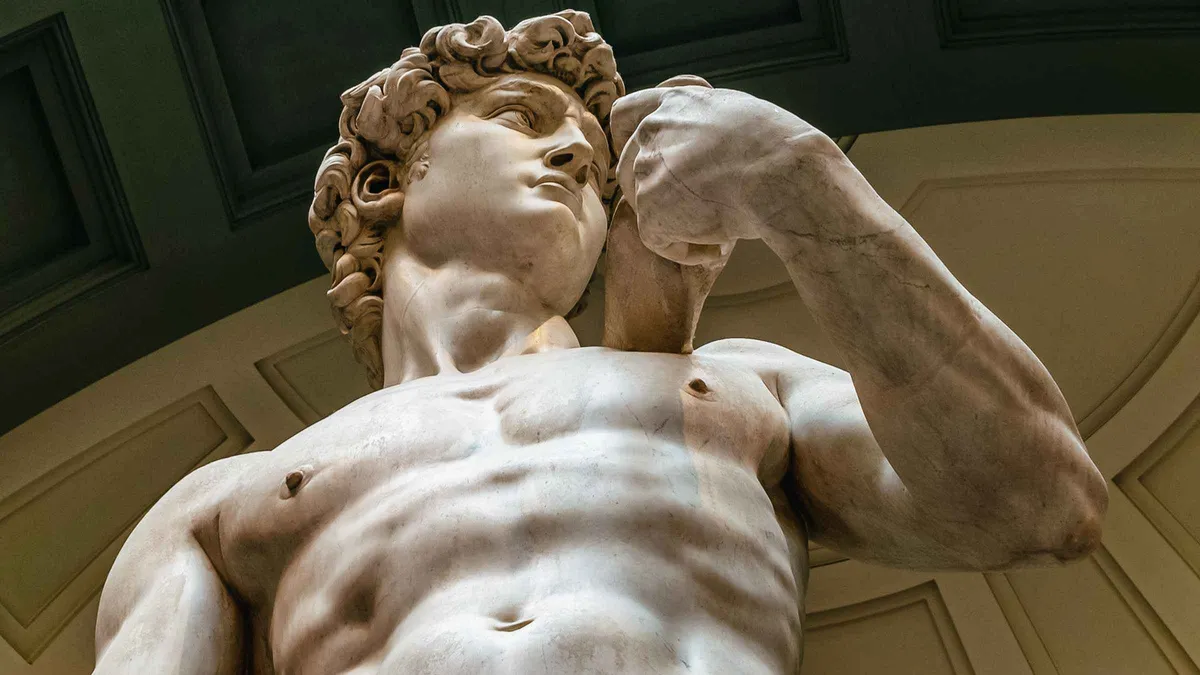 from €37
Best seller
from €37
Best seller
Florence: Michelangelo's David Skip-the-Line Entry Ticket
listed at $43.79
Skip-the-ticket-line Accademia entry collected for you by a local agency; optional audioguide or VR add-on. Security queue up to 20 minutes.
Check Availability from €30
Florence: Uffizi & Accademia Timed Tickets with Audio App
listed at $35.32
Timed tickets to both Uffizi and Accademia with a mobile audio app in 18 languages and a Tuscan truffle-oil tasting. Non-refundable.
Check Availability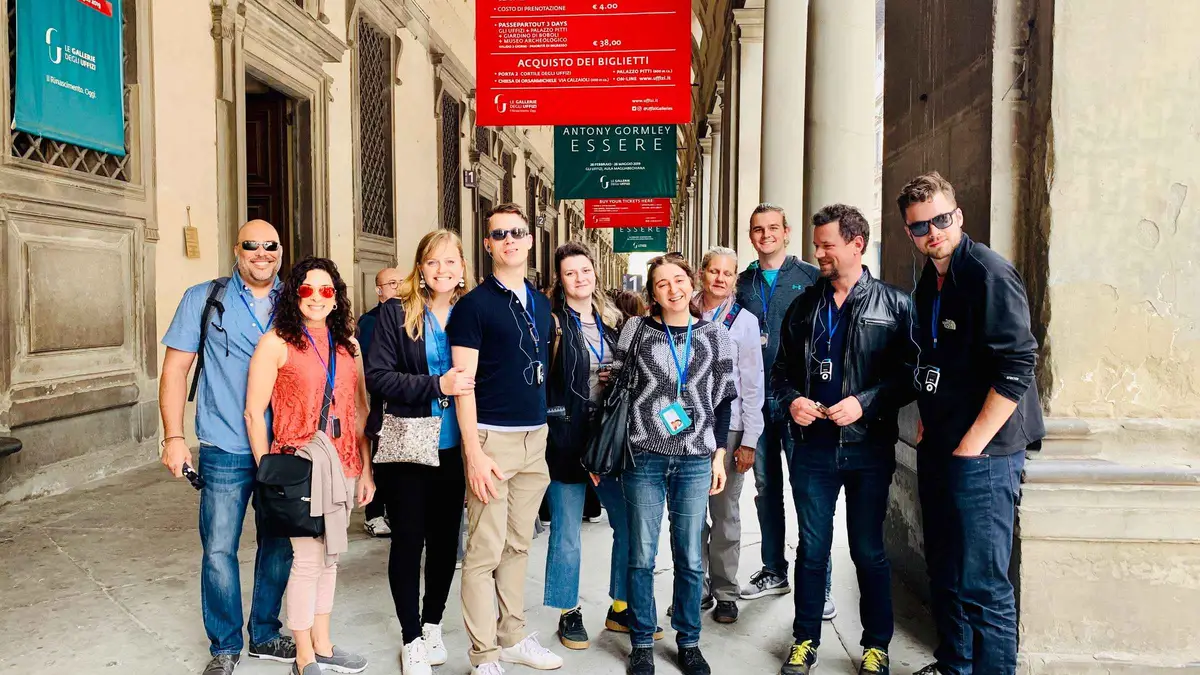 from €64
Florence: Uffizi Gallery Small-Group Guided Tour with Ticket
listed at $75.13
90-minute small-group Uffizi tour with ticket and headsets; guides in 7 languages. Skip the ticket line, then stay inside on your own after the tour.
Check Availability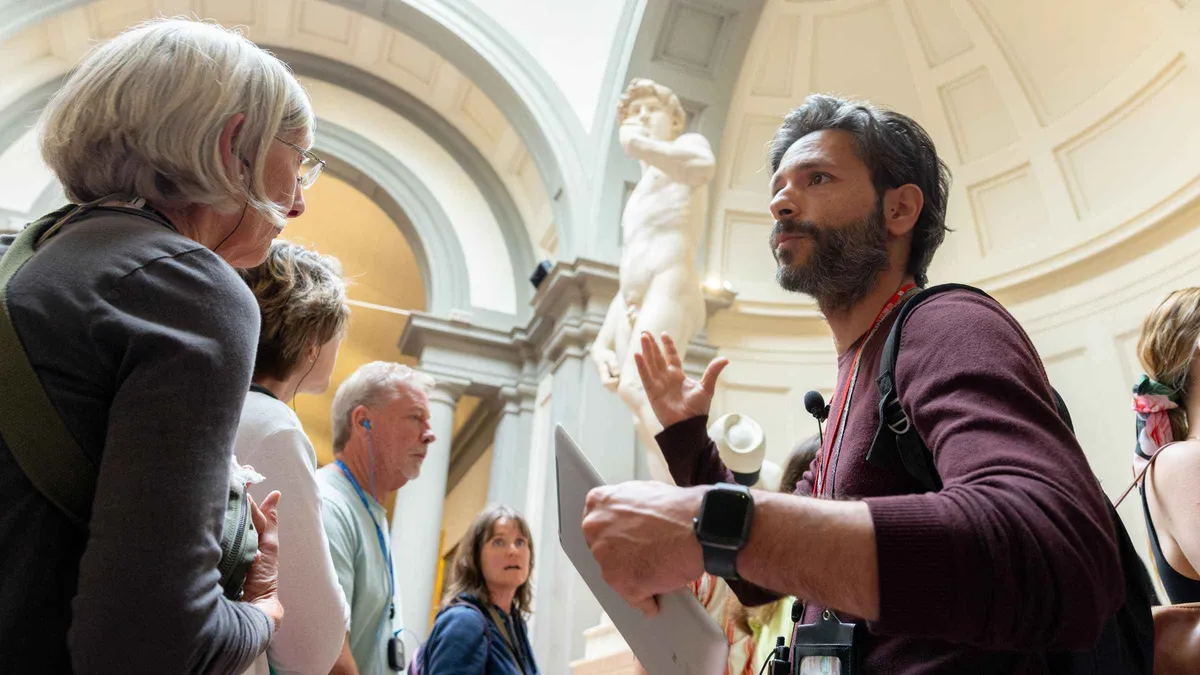 from €41
Top rated
from €41
Top rated
Florence: Accademia Gallery Guided Tour Timed Entrance
listed at $47.91
One-hour guided Accademia visit with a reserved timed ticket and headsets; six languages plus a max-10 small-group option.
Check Availability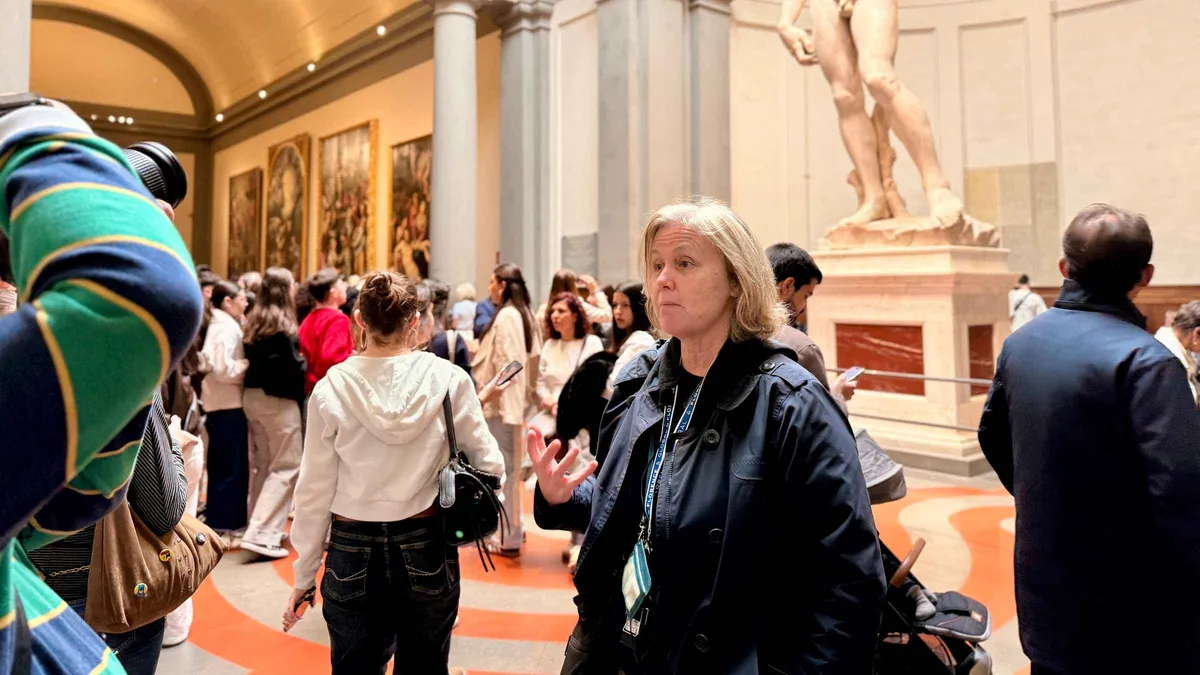 from €45
Florence: Uffizi & Accademia Small Group Walking Tour
listed at $52.81
Four hours with one guide across the Accademia and Uffizi, plus Duomo Square and Piazza della Signoria between them. Groups of 10–15.
Check AvailabilityPrices, ratings and details are the platform's own. Dollar figures are the listed prices. The platform bills in your account's currency.
Doing both in one day, and the walk between them
The two galleries sit about a kilometre apart in a straight line, roughly twelve to fifteen minutes on foot through the middle of the city. No official source publishes walking times, so treat that as our estimate rather than a timetable. The route runs from Piazzale degli Uffizi up past Palazzo Vecchio, along Via dei Calzaiuoli under the Duomo's flank, and out to Via Ricasoli, which means the walk between the two museums is itself a tour of the centre.
The order matters more than the distance. Take the Accademia first, at or near opening: it is the shorter visit, its queue is worst late morning, and finishing there by ten leaves the rest of the day open. Then walk up to the cathedral, eat something, and take an afternoon Uffizi slot, ideally from 16:00, when the gallery is at its emptiest.
What not to do is book two adjacent slots and try to make a schedule out of it. Both museums admit you at a time and stop caring afterwards, so the risk is entirely on your side: a slow queue at the first one turns the second one into a sprint. Leave three hours between the two entry times and the day works.
If you would rather not decide at all
There is a middle path, which is to buy the combination and let the itinerary sort itself out. The five-day Passepartout at €68 (about $80) covers the Uffizi with Pitti Palace and the Boboli Gardens on one ticket, which suits anyone staying three nights or more. Note that it does not include the Accademia, because that museum sits in a different state group.
For the two galleries specifically, the Uffizi tickets page and the Accademia tickets page list the entries and guided visits for each, with what each one actually includes.
Uffizi vs Accademia: the questions people actually ask
Is Michelangelo's David in the Uffizi or the Accademia?
The Accademia. The original has stood there since 1873, under a dome built for it. The figure in Piazza della Signoria is a copy placed on the statue's original spot in 1910, and there is a second bronze copy at Piazzale Michelangelo. A timed David entry reserves the hour, and the Accademia guide covers what else is in the building.
Is the Accademia worth it for one statue?
If David is a thing you have wanted to see, yes. The room and the approach along the corridor of unfinished Prisoners do something no photograph manages. If you are ambivalent about it and short on time, the honest answer is that the Uffizi gives you more to look at, and the Uffizi guide shows what that hour buys instead. Under-18s enter the Accademia free, any nationality, which changes the family arithmetic completely.
Can you see both the Uffizi and the Accademia in one day?
Comfortably, yes, as long as the entry times are at least three hours apart. Take the Accademia at opening and the Uffizi in the afternoon. The walk between them is about a quarter of an hour. A combined timed pair books both entrances in a single transaction, and the one-day Florence plan puts the rest of the day around them.
Which one has the worse queue?
The Accademia, in the sense that its queue is the more visible one. It forms on the pavement of Via Ricasoli, and the museum says outright that without a reservation the wait may be long. The Uffizi absorbs its crowd inside a courtyard and behind timed doors, so it feels calmer even when it is fuller. Both problems disappear with a booked slot, and the ticket index lists every route to one.
Do the two galleries close on the same day?
Yes. Both are state museums, so both close on Mondays and on 1 January and 25 December. That is the single most common wasted morning in Florence, and the Monday and Sunday openings table exists because of it: the Duomo complex, Palazzo Vecchio and most of the churches are open on the day the two galleries are not.
Is a late-afternoon Uffizi slot enough time?
Yes. The gallery stays open until 18:30, so a slot at 16:00 leaves two and a half hours, which is more than the highlight run needs. The catch is only that you cannot linger past closing, and that the top floor empties first. A reserved entry with audioguide books the afternoon slot, and the Uffizi tickets page lists the other ways in.
Inside Both Galleries, Before You Choose
Three walk-throughs that show what the two visits actually feel like from the inside: the Uffizi's room-by-room route, its highlight run, and the approach to David.
See the Uffizi in 2 Hours: Don't Miss These Masterpieces
The two-hour highlight route through the Uffizi, painting by painting, which is the visit most first-timers are actually planning.
Video: Our Big Italian Adventure7 Masterpieces Not to Miss at the Uffizi Gallery
What to look at if you have decided on the Uffizi and want the shortest defensible version of the visit.
Video: the tour guyBest Way to See the Michelangelo David in Florence
The Accademia side of the decision: the corridor, the tribune and how long people really spend in front of the statue.
Video: the tour guyVideos load from YouTube only when you press play.