 Florence City Guide
Gluten-Free and Vegan in Florence
Eating gluten-free Florence, or vegan Florence, is easier than the internet suggests and harder than the restaurant next door suggests, and both halves matter. Italy has a national certification programme for eating out, run by AIC, the Italian coeliac association — and its list of certified venues is not public. This page, part of our coverage of things to do in Florence, explains what that certification actually obliges a kitchen to do, which Florentine dishes are safe by construction and which look safe and are not, the Italian sentences that get the right answer, and eleven places we can name because a published guide or the venue's own site says so. The food itself — the steak by weight, the coperto, when the kitchen is open — is on the eating page; this one is only about what is in the plate.
Quick answer What the certification means, which dishes are traps, what to say
Florence is a workable city on a gluten-free diet and an easy one on a vegetarian diet, and the reason is structural: Italy runs a national certification scheme for restaurants, and Tuscan cooking is built on beans, bread, vegetables and oil rather than butter and cream. The complication is that the certified list is reserved for AIC members, and that the most famous Florentine dishes — ribollita, panzanella, pappa al pomodoro, crostini, lampredotto in its bun — are bread dishes wearing a vegetable name.
Key takeaways
- The certification to look for is AIC's Alimentazione Fuori Casa: the venue has taken a course on coeliac disease, follows AIC's preparation rules and is inspected at least once a year — what that actually obliges a kitchen to do.
- The list of certified venues is members-only, so the eleven places on this page are named on a different basis: a published guide, or the venue's own published claim, printed on the card with its year.
- Half of Florence's vegetable dishes are bread dishes and half of its vegetable soups start in meat stock — the dish-by-dish table says which is which and where each one goes wrong.
- Learn four sentences before you sit down. “Sono celiaco” and “senza glutine” work; “vegetariano” is the one that gets misread — the phrases, with what each one does.
- Want to control the ingredients yourself? The food hall at the market building trades 9:00 to 23:00 and sells the components rather than the dish, and a pasta class from €16 (about $19) lets you ask the kitchen before you pay.
What An AIC Certification Actually Guarantees
Italy is one of the few countries where eating out on a gluten-free diet has a national scheme behind it rather than a menu symbol. It is worth knowing exactly what it covers before you decide how much weight to put on it.
AIC — the Associazione Italiana Celiachia, the Italian coeliac association — has run a programme called Alimentazione Fuori Casa, “eating away from home”, since 2000. A restaurant, bar, pizzeria, hotel or agriturismo joins it, and from that point the association's local branch treats the kitchen as something it audits rather than something it recommends. The obligations are specific, and they are the reason the badge means more than a line on a menu.
The five obligations above are AIC's own description of the programme, condensed. Note what the scheme does not promise: it is not a 100% gluten-free kitchen. Unless the venue says the whole kitchen is given over to gluten-free cooking — and three of the places further down do say exactly that — a certified venue is a mixed kitchen running a controlled process.
For most coeliac travellers that is the right level of assurance. If you are at the cautious end, the dedicated kitchens are the ones to book.
| What the venue signs up to | What it means at your table |
|---|---|
| A course on coeliac disease and the gluten-free diet, run by the local AIC branch or a health authority, plus further training on the premises | Somebody in that building has been taught what gluten is and where it moves, rather than having read the word on a supplier's box |
| Following AIC's own rules for preparing and serving gluten-free food, using gluten-free ingredients for those dishes | Separate preparation is the point of the scheme: the gluten-free plate is built along its own path through the kitchen |
| A named referente inside the venue who carries responsibility for the gluten-free service | There is a person to ask for, and the owner is obliged to keep the rest of the staff informed |
| A signed agreement with AIC committing to all of the above | It is a contract, not a courtesy |
| An in-depth inspection of the premises by the local AIC branch at least once a year | The listing goes stale on a schedule, and can be withdrawn |
The list is real, and it is not public
Here is the part nobody writes down. AIC's register of participating venues is reserved for AIC members, who receive an access code when they join, and the association states plainly that it does not share the database with third-party websites — which is why every “certified gluten-free Florence” listicle you find is somebody's memory of a badge on a door rather than a copy of the register. Visitors have one honest route in: the AIC Mobile app sells a 15-day Welcome version, and it is available in English.
If you are coming for a week and you are coeliac, that fifteen-day pass is the single most useful thing you can buy before the flight. AIC Toscana, the regional branch that covers Florence, sits at Via Vasco de Gama 25 and takes questions by phone and email; the list still comes through membership, not through the branch.
We could not read the register ourselves, so we do not print a “certified” claim we cannot verify. Where a venue below publishes its own AIC recognition, the card says so, with the year and the page it came from; where it does not, the card says what the venue does claim and leaves the rest blank.
What “Senza Glutine” Means In Law, And What AIC Says About Crumbs
Two figures decide what you can safely order in Italy, and one widespread fear turns out, on the association's own scientific advice, to be misplaced. Both come from AIC's published material.
The wording senza glutine is regulated. Under Regulation (EU) 828/2014 it may only be used where the finished food holds no more than 20 mg/kg of gluten — 20 parts per million. A second category, “very low gluten”, covers 21 to 100 ppm; AIC advises coeliacs to keep that category to a minimum, notionally a fifth of what they eat from the certified 20 ppm range.
In practice, in a Florentine restaurant, the phrase on the menu is what carries the legal weight, and the pre-packed products in a supermarket carry the crossed-grain symbol and the claim on the label.
The counter-intuitive half comes from the scientific board of the same association, in its document on contamination. Coeliac disease is not an allergy: there is no risk of anaphylactic shock from gluten, which is why the reaction to a mistake is damage over time rather than an emergency in the dining room. Flour in the air does not, by itself, harm a coeliac. And any well-washed pot, plate, fork or wooden spoon, of any material, can be used for a gluten-free dish — separate pan sets and separate sponges are not required.
What matters is cumulative: the association works from a daily intake of around 10 mg of gluten as the level to stay under, and stresses that nobody can add up a day's worth of stray traces, which is why the rule is behavioural rather than arithmetic.
The practical consequence is a shorter worry list than most travel advice gives you. Stop policing the cutlery. Do ask about the things that carry flour into a dish invisibly — a thickened sauce, a shared fryer, the bread basket parked on your plate — and, in AIC's own words, do not hesitate to declare your condition in a restaurant, so that the people running it can take the precautions that protect you.
A kitchen that is told at the door behaves differently from a kitchen told at the pass.
Florentine Dishes, Dish By Dish: The Safe Ones And The Traps
This is the table we wanted when we started: what each classic Florentine dish is made of, whether it works gluten free and whether it works without animal products. The dish definitions come from the official sources behind the food page — Regione Toscana's traditional-products register, the Vetrina Toscana recipe archive and the Pane Toscano DOP consortium; the verdicts in the last two columns are our reading of what each dish is, not a statement by any venue, so treat them as the general rule and confirm at the table.
Twelve dishes, four columns. The first two columns say what the dish is made of; the last two are our reading of it for a gluten-free and for a plant-based table, so treat them as the general rule and confirm the version in front of you at the table.
| Dish | Gluten | Animal products | Where it goes wrong |
|---|---|---|---|
| Bistecca alla fiorentina | None in the meat | Beef, the whole point | The grill also cooks bread; ask before assuming the char is clean |
| Fagioli all'olio / all'uccelletto | None | Vegan as written | Some kitchens start the pan with pancetta |
| Ribollita | Bread soup — stale Tuscan bread is an ingredient | Usually vegan, cavolo nero and cannellini | There is no gluten-free ribollita unless the kitchen rebuilds it; grated cheese often arrives on top |
| Panzanella | Bread salad | Vegan without the anchovy | Anchovy and tuna wander into tourist versions |
| Pappa al pomodoro | Bread and tomato | Usually vegan | Some kitchens loosen it with meat stock |
| Crostini toscani | On bread, and the topping is chicken liver | Not vegetarian | The classic Florentine starter is the least vegetarian thing on the menu |
| Lampredotto or trippa panino | The bun, not the meat | Beef offal | The meat is naturally gluten free; the roll it is dipped in is not, and the same broth pot serves both |
| Trippa alla fiorentina | None as written | Beef offal | Some versions are finished with cheese |
| Schiacciata and pane sciocco | Wheat, by definition | Vegan as written | The bread on the table arrives with the coperto whether you ordered it or not |
| Pasta fresca (pici, tagliatelle, tortelli) | Wheat, unless the kitchen makes a gluten-free version | Egg in most fresh pasta; pici are usually flour and water | Two Florence kitchens make gluten-free fresh pasta in a dedicated kitchen — both are on the cards below |
| Fagioli, cavolo nero, artichokes, porcini | None | Vegan | The stock they are simmered in is the variable |
| Gelato | Only in the cone, the biscuit inclusions and some flavour bases | Milk in the crema family; fruit sorbetto is usually water-based | The scoop and the tub — see the gelato section below |
The pattern behind the table
Read the pattern rather than the rows: Tuscan peasant cooking uses bread as an ingredient, not as a side. Four of the dishes a visitor comes to Florence for — ribollita, panzanella, pappa al pomodoro, crostini — are bread dishes with a vegetable name, which is why a coeliac who orders “the soup” because it sounds like vegetables ends up sending it back. The compensation is that the same cooking is unusually kind to vegans: beans, cavolo nero, chickpeas, artichokes and olive oil carry most of the tradition, and dairy plays a smaller part in Tuscany than it does in the north.
The Traps That Are Never Printed On The Menu
None of these is on a menu, and none of them is dishonesty. They are the ordinary habits of an Italian kitchen, and each one has a question that defuses it.
Seven habits that put gluten or meat in a plate that looks clean
- The coperto bread. A per-person cover charge brings bread to the table before you have ordered, on every bill in Tuscany. It arrives, it gets broken over the tablecloth, crumbs land on the plate that your food will be served on. Say “senza pane, per favore” as you sit down — not after the basket lands.
- Flour in the sauce. A thickened sauce, a ragù stretched with a roux, a gravy finished with flour: none of it shows. This is the single most common route into a plate that otherwise looks fine, and the reason the question to ask is “c'è farina?” rather than “is it gluten free?”
- The shared fryer. Fried zucchini flowers, fritto misto and battered vegetables come out of the same oil in most kitchens; that oil carries flour from everything fried in it. A dedicated fryer exists in serious gluten-free kitchens and nowhere else. We are reasoning from how a fryer works here, not quoting a rule — AIC's own contamination guidance covers utensils and flour dust, not fryers.
- The pasta water. One pot, all day, every shape. A kitchen that cooks gluten-free pasta in fresh water in a separate pot will tell you so if asked, and one that does not will hesitate — the hesitation is the answer.
- The lampredotto bun. The best cheap lunch in the city is a boiled-offal sandwich, and the meat is gluten free while the roll is not. Asking for it “in a bowl”, senza panino, is a normal request at the carts — the vendors sell trippa in a tub all day. The broth the roll gets dipped in has had bread through it, though, so ask them not to dip.
- Brodo di carne. The most frequent vegetarian trap in Tuscany: a vegetable soup, a risotto or a plate of tortelli built on meat stock. “Con brodo vegetale?” is the question, and the honest answer is often no.
- Lardo, pancetta and the anchovy. Beans, cabbage and greens are often started in cured pork fat, and anchovy dissolves invisibly into dressings and sauces. Neither reads as meat to a Tuscan cook.
Say it before the order, not after
Say them at the start of the meal rather than at the end. A Florentine kitchen that hears the constraint before it fires the order will usually solve it — the grilled vegetables, the beans, the bistecca, the pecorino and pear plate are all standing answers, and none of them is a compromise dish invented for you.
The Sentences That Work, In Italian
Say these as written. They are our translations rather than anybody's official script, but each one is phrased the way an Italian kitchen expects the constraint to arrive — as a fact about you first, then the practical consequence.
One word deserves its own warning. “Vegetariano” is routinely heard in Italy as “no meat”, with fish quietly exempt — a plate of pasta with clams can arrive in perfectly good faith. We have no source to point you at for that; it is advice, not a fact, and the fix costs nothing: say “non mangio carne né pesce” and the ambiguity disappears. The same goes the other way for coeliacs — “intollerante al glutine”, gluten intolerant, gets you a softer version of the care that “celiaco” gets, because the second word is the one that triggers the kitchen's protocol.
| What you need | What to say | What it does |
|---|---|---|
| Coeliac disease | Sono celiaco / sono celiaca — non posso mangiare glutine | Names the condition, which is the sentence Italian kitchens are trained on. Do not soften it to a preference |
| The kitchen question | C'è farina nel sugo? Avete una cucina separata per il senza glutine? | Flour in the sauce, and whether there is a separate preparation — the two things that actually decide the plate |
| No bread on the table | Senza pane, per favore — grazie | Stops the coperto basket arriving; say it while you are sitting down |
| Vegan | Sono vegano / sono vegana — niente carne, niente pesce, niente latticini, niente uova | Spell out the four. “Vegano” alone is understood in central Florence and less so on the hills |
| Vegetarian | Non mangio carne né pesce | The safe wording. See the warning below |
| Dairy-free | Senza latticini — niente burro, niente panna, niente formaggio | Butter, cream and cheese named separately, because “latte” is heard as the drink |
| The stock question | È fatto con brodo vegetale o brodo di carne? | The one question that separates a vegetarian soup from a meat one |
Eleven Places, And Who Vouches For Each One
Because AIC's register is members-only, none of these cards claims a certification we verified ourselves. Each one says instead exactly who names the venue — the MICHELIN Guide, Gambero Rosso's gelato guide, Vetrina Toscana (the food-and-wine network run by Regione Toscana), or the venue's own published words — with the year, so you can weigh it and see when it will go stale. Addresses open in Google Maps. Hours come from each venue's own site, and where a venue publishes none we say so rather than copy a directory.
-
Ristorante Quinoa
The dedicated kitchen, and the reason it heads this list: Quinoa says on its own site that it has been a 100% gluten-free restaurant since 2014, certified by the national coeliac association, with nothing containing gluten anywhere in the building. It sits in a garden inside a sixteenth-century cloister a few minutes from the Duomo, and the cooking is Tuscan crossed with a lighter, more Asian hand. If you are the cautious end of coeliac — or you are travelling with a child who is — this is the booking that removes the conversation entirely.
- Address
- Vicolo di Santa Maria Maggiore 1
- Hours
- 11:00–24:00
- Closed
- Not stated on its own site
-
Sgrano (via dei Neri)
Sgrano states that the kitchen at its Florence addresses is given over entirely to gluten-free preparation, and that it has been recognised by AIC in the Alimentazione Fuori Casa programme. It also says its food is, or can be, cooked without lactose — rare enough to matter if you are managing both. One caveat we would rather print than hide: the page carrying that claim now survives only as an archived copy from June 2024, the live site no longer publishes it, and AIC's register is members-only, so we could not re-verify the listing ourselves.
- Address
- Via dei Neri 49/R
- Hours
- Not stated on its own site
- Closed
- Not stated
-
Osteria dello Sgrano
The sit-down half of the same operation, in via dei Benci a short walk from Santa Croce, recognised by AIC in the same programme from 2023 according to the company's own page. What it is actually for is fresh pasta: tagliatelle, pici, gnocchi and tortelli made by hand in a gluten-free kitchen, which is the plate a coeliac normally gives up on in Italy. Its own site publishes no hours; the phone number on the site is 055 226 0204.
- Address
- Via dei Benci 30/R
- Hours
- Not stated on its own site
- Closed
- Not stated
-
Pizzeria La Luna
Pizza is the dish coeliac travellers miss most in Italy, and La Luna on via Gioberti, east of the centre, has been making a gluten-free version for years: its own site advertises a wide gluten-free choice of dishes and pizzas from its own separate production, cooked in the wood oven. It is a neighbourhood restaurant rather than a destination, twenty minutes' walk or a tram ride from the Duomo, with a second room a few doors along at 46r. Its own site makes no AIC claim, so we make none for it.
- Address
- Via Gioberti 93/R
- Hours
- 12:00–15:00 and 19:00–24:00
- Closed
- None stated — open daily
-
Starbene Gluten Free
The bakery. An entirely gluten-free forno and pastry counter two minutes from Piazza Santa Croce, which is the answer to the hardest meal of a coeliac's day in Italy — breakfast. Schiacciata, filled rolls, cakes and pastries, all of it from a kitchen with no wheat in it. Its own site advertises free delivery anywhere in the comune of Florence on orders above €20 (about $23) with 24 hours' notice, and it accepts the Tuscan health service's gluten-free vouchers, which is a detail aimed at residents rather than visitors but tells you what kind of shop it is. It publishes no opening hours of its own.
- Address
- Via dei Neri 13/R
- Hours
- Not stated on its own site
- Closed
- Not stated
-
Cuculia
The vegetarian and vegan entry we trust most, because the MICHELIN Guide's own 2026 inspector text says it plainly: the menu clearly marks its vegetarian dishes, alongside a few written for vegans. It is a bistro-quiet room with a small library of cookbooks on via dei Serragli in the Oltrarno, the chef cooks seasonal Tuscan produce with kombu, soy and koji in the background, and the Guide places it in its most expensive band — this is the dinner, not the lunch.
- Address
- Via dei Serragli 3/rosso
- Hours
- Not stated by the Guide
- Closed
- Not stated
-
Ristorante Da Lino
Two minutes from the Duomo on a lane most visitors walk past, and listed by Vetrina Toscana — the food-and-wine network run by Regione Toscana, the regional government — under both its Senza glutine and its Vegetariano tags. That tag is a declaration by the restaurant to an official network, not an AIC audit, and the difference matters: it means the kitchen caters for the diet, not that its process has been inspected. As a central, ordinary Tuscan restaurant that will take the request seriously, it is a good default.
- Address
- Via Santa Elisabetta 6/r
- Hours
- Not stated on the listing
- Closed
- Not stated
-
Aroma
A small room on via Ghibellina, also carrying both the Senza glutine and Vegetariano tags on Vetrina Toscana, with fish from the Tuscan coast arriving daily. Read its own description carefully before you book: bread, pasta and desserts are made in house every day, which is exactly the profile where the gluten-free question has to be asked about the process rather than the menu. It closes on Monday lunchtime.
- Address
- Via Ghibellina 67r
- Hours
- Not stated on the listing
- Closed
- Monday lunchtime
-
L'Ortone
The trattoria opposite the Sant'Ambrogio market, in the Santa Croce quarter, which the food page names for its steak: it also carries the Senza glutine and Vegetariano tags on Vetrina Toscana. Useful for a mixed table — the kind of evening where one person wants the bistecca and another wants a plate of vegetables and beans, and neither has to eat somewhere they did not choose.
- Address
- Piazza L. Ghiberti 87/R
- Hours
- 12:15–14:30 and 19:15–22:30, daily
- Closed
- None stated
-
La Sorbettiera
The gelato card that answers the most questions. Its own site states that every flavour is gluten free and some are lactose free, and that the artisan cone is gluten free too — which is the one thing a gelateria almost never publishes. Gambero Rosso's Gelaterie d'Italia 2027 gives it Due Coni. Four counters in the city; the Piazza Tasso and Via Mazzetta ones sit either side of Santo Spirito, in the Oltrarno.
- Address
- Via Mazzetta 9a
- Hours
- Not stated on its own site
- Closed
- Not stated
-
Gelateria della Passera
The one Florence address holding Tre Coni, the top mark, in Gambero Rosso's Gelaterie d'Italia 2027 — a counter the size of a wardrobe on the little square behind Santo Spirito. We include it with a caveat rather than a promise: Passera publishes no allergen information and no flavour list on its site, so the sorbet-versus-crema and the shared-spatula questions have to be asked at the counter, in the order set out below.
- Address
- Via Toscanella 15/R
- Hours
- Not stated on its own site
- Closed
- Not stated
Not a ranking, and not a complete list. It is the set of Florence venues we could attach a published source to, which is a different thing. Certification claims are the venue's own unless the card names a guide.
Gelato: Which Bases Have No Milk, And The Two Questions To Ask
Gelato is where a dairy-free or vegan traveller in Italy either eats well every afternoon or gives up, and the difference is two questions at the counter. The composition below is the general rule for how the two families are made, not a legal definition — Italy regulates the word gelato loosely and each shop writes its own recipe.
Italian gelato splits into two bases. The crema family — fiordilatte, pistachio, hazelnut, chocolate in most shops, anything custard-coloured — is built on milk, and often on egg yolk as well. The sorbetto family, which is where the fruit lives, is built on water, sugar and fruit, and is therefore dairy free by construction: lemon, strawberry, raspberry, melon, and in a good shop pear, fig and grape in their weeks.
Dark chocolate is the useful exception — a cioccolato fondente made to the sorbetto method is water-based, which is why an all-fruit cup does not have to be a sad one. None of this is guaranteed by law; a shop can put milk into a fruit flavour and several do, which is exactly why you ask.
- “È a base di acqua o di latte?” — water base or milk base. The one question that sorts the whole counter in a sentence, and the staff at a serious gelateria answer it instantly.
- “Usate una spatola pulita?” — a clean spatula. One scoop moves between tubs all day; for a milk allergy or for coeliac disease this matters more than the flavour does, and the answer at a busy counter in August is often no.
- The cone is wheat unless the shop says otherwise, so ask for a coppetta — a tub — unless, like La Sorbettiera above, the shop publishes a gluten-free cone.
- Biscuit inclusions travel: stracciatella, cookie and tiramisù flavours put crumbs into the tub beside yours.
If you would rather not run the interrogation twice a day, the shortcut is to pick one counter that has published its answers and keep going back. On this page that is La Sorbettiera, which states the gluten position for every flavour and for its cone on its own site — our decision, on the evidence we could read, not a ranking of the gelato itself.
Vegan Wine, And The Lunch You Build Yourself
Two loose ends that decide a lot of meals: whether the glass of Chianti in front of you is vegan, and what to do about the hours when no kitchen in Florence is cooking.
Wine is not automatically vegan, and the label will not tell you
Wine is clarified before bottling, and the traditional fining agents are animal: casein from milk, albumin from egg white, isinglass from fish. Since 1 July 2012, under Commission Implementing Regulation (EU) No 579/2012, an EU wine label has had to declare milk- and egg-derived fining agents — but only where residues are still detectable at or above 0.25 mg per litre. The consequence is the part that matters to you: a label saying nothing does not prove the wine is vegan, because a wine fined with casein and then filtered clean carries no declaration at all.
Ask the enoteca, or look for the producers who state “non filtrato” or “vegan” on the back label; Tuscan natural-wine bars are used to the question and answer it without ceremony.
The market solves the afternoon
Between roughly 15:00 and 19:30 most Florentine kitchens are shut, which is the hardest window of the day on a restricted diet because the places still open are bars selling sandwiches. The reliable answer is the first-floor food hall inside the market building, open every day 9:00 to 23:00, where the counters are separate businesses and you can watch the plate being built. Between them the two market halls are the only place in Florence where you buy a lunch whose ingredients you control from end to end.
Downstairs, and at the Sant'Ambrogio market over in the Santa Croce quarter, you are buying components rather than dishes: tomatoes, peaches, figs, artichokes in their season, cannellini beans, olives, chickpea flour, whole pecorino for those who eat it. A picnic assembled from a market stall is the only lunch in the city where you control every ingredient, and — as the cost page sets out — it is also the cheapest one. Once you have eaten your way through the market stalls on your own terms, tours in Florence can show you how the city's other food quarters fit around them.
Two cautions on markets. Cured meats and cheeses are sliced on shared machines, which is a problem for a milk allergy rather than for a coeliac; and the schiacciata sold from the bakery stalls is wheat, so the bread half of the picnic has to come from a gluten-free bakery like the one on the cards above.
Cooking And Eating With Somebody Who Can Ask For You
A guide is worth real money on a restricted diet, because the constraint gets explained by somebody the kitchen already knows. Four products, with the platform's own prices and ratings. Dollar figures are approximations at €1 = $1.17. None of the four publishes a dietary guarantee on its listing, so send the operator a message through the booking before you pay — substitutions are the operator's call, not the platform's, and a pasta class in particular is a wheat-flour room. Figures current in Q3 2026.
 from €16
Best seller
from €16
Best seller
Florence: Pasta Cooking Class with Unlimited Wine
listed at $18.53
Make three fresh pastas with a chef inside a 1200s tower once owned by Dante's wife's family, then eat it all with unlimited Tuscan wine.
Check Availability from €42
Top rated
from €42
Top rated
Florence: Street Food Tour with Wine & Local Guide
listed at $48.65
2.5-hour street-food walk through San Lorenzo Market and the Duomo area with several tastings and a sip of wine; morning only, no vegan or gluten-free.
Check Availability from €25
Florence Cooking Class: Market Tour & Lasagna or Fresh Pasta
listed at $28.96
Choose a Central Market tour with lasagna and tiramisù, or a fresh-pasta class with gelato tasting and unlimited wine; professional chefs, recipe booklet.
Check Availability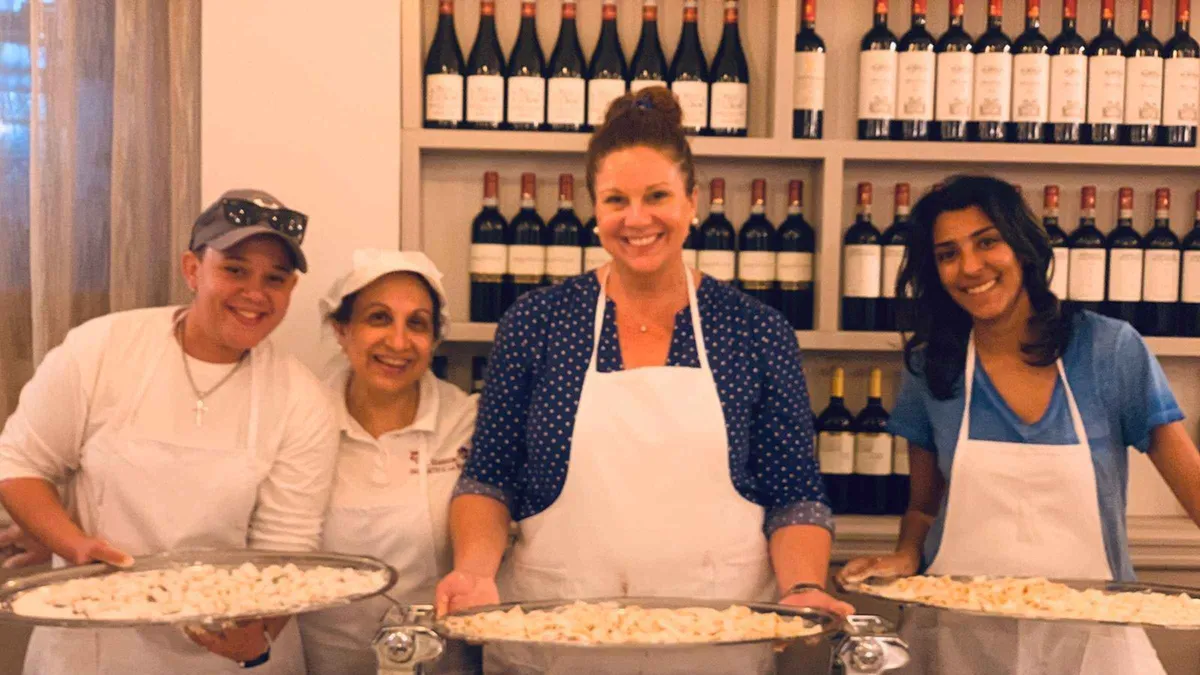 from €42
Top rated
from €42
Top rated
Florence: Pasta & Tiramisu Cooking Class with Unlimited Wine
listed at $48.65
Three-hour pasta and tiramisù class in a local restaurant with wine pairing, then coffee or limoncello; vegan and gluten-free variants on request.
Check AvailabilityPrices, ratings and details are the platform's own. Dollar figures are the listed prices. The platform bills in your account's currency.
Where To Go Next
What the dishes actually are
The steak sold by weight, the tripe carts, the coperto and when the kitchen is open: the Florence eating page.
The companion page to this oneThe market building
Stalls, the food hall and the hours that cover the afternoon: the market building itself.
8 minutes' walk from the DuomoEating with a guide
Cooking classes and street-food walks compared, with what each one excludes: every food tour and cooking class. Or start again at what to see in Florence.
From €16 (about $19)Dietary Questions About Florence
Is Florence good for coeliacs?
Yes, better than most European cities, for a structural reason: Italy runs a national restaurant certification scheme through AIC, the coeliac association, and Florence has several kitchens that are entirely gluten free rather than merely accommodating. The catch is that the certified list is members-only — what the certification obliges a kitchen to do, and how to see the list.
How do I find the AIC-certified restaurants in Florence?
Through AIC membership, or through the AIC Mobile app, which sells a 15-day Welcome pass and has an English version. The association does not share its register with other websites, so any list you find elsewhere — including the eleven places on this page — is sourced some other way and should say so.
Which Florentine dishes contain gluten when they do not look like it?
Ribollita, panzanella and pappa al pomodoro are all bread dishes; crostini toscani are served on bread; the lampredotto panino is gluten free apart from the roll it is served in and dipped with. The full breakdown, dish by dish, is in the table above.
Is Tuscan food easy for vegans?
The ingredients are: beans, cavolo nero, artichokes, chickpeas and olive oil carry most of the tradition and butter plays a small part. The traps are stock and fat — meat broth under a vegetable soup, lardo or pancetta starting a pan of beans, anchovy in a dressing. Ask “è fatto con brodo vegetale?”, and see the sentences that work.
Does “vegetariano” mean no fish in Italy?
Not reliably. The word is often heard as “no meat” with fish exempt, so a vegetarian order can arrive with clams in it in perfectly good faith. Say “non mangio carne né pesce” instead. This is our advice from how the word is used rather than a sourced rule — the phrase table gives the wording.
Is gelato in Florence dairy free or vegan?
The sorbetto flavours — the fruit ones, and a dark chocolate made the same way — are water-based and therefore free of milk; the crema flavours are not, and often carry egg yolk too. Ask “è a base di acqua o di latte?”, ask for a tub rather than a cone, and see the gelato section.
Can I get gluten-free pizza and fresh pasta in Florence?
Yes to both, and both are on the cards above: a pizzeria on via Gioberti running its own gluten-free production, and an osteria near Santa Croce making gluten-free pici, tagliatelle and tortelli by hand in a dedicated kitchen. Details and sources are on the venue cards.
Is Italian wine vegan?
Not by default. Wine is commonly clarified with casein, egg albumin or isinglass, and EU labelling only forces a declaration where residues remain detectable, so a silent label proves nothing — the wine note explains what to ask for instead.
Eating Gluten Free In Italy, On Film
Three clips filmed by coeliac travellers rather than by restaurants, useful for seeing what a gluten-free counter in Florence actually looks like before you are standing at one.
The BEST Gluten Free Restaurants in Florence | Traveling with celiac disease
A coeliac traveller works through Florence's dedicated gluten-free kitchens, including the pizza and pasta ones.
Video: Celiac Sarah ExploresGluten-Free in Italy: Travel Tips You Need to Know
The practical layer this page describes — how to ask, what the certification means, what to watch for at a counter.
Video: Robyn's Gluten-free LivingGLUTEN-FREE IN ITALY!! Everything I Ate + Did in Rome & Florence 2025
A week of gluten-free meals across two Italian cities, filmed plate by plate, including gelato counters.
Video: Jenn LuekeVideos load from YouTube only when you press play.
Prices, hours and terms are set by the venue or operator and confirmed at checkout.
We may earn a commission if you book through one of our links, at no extra cost to you. Full affiliate disclosure