 Florence City Guide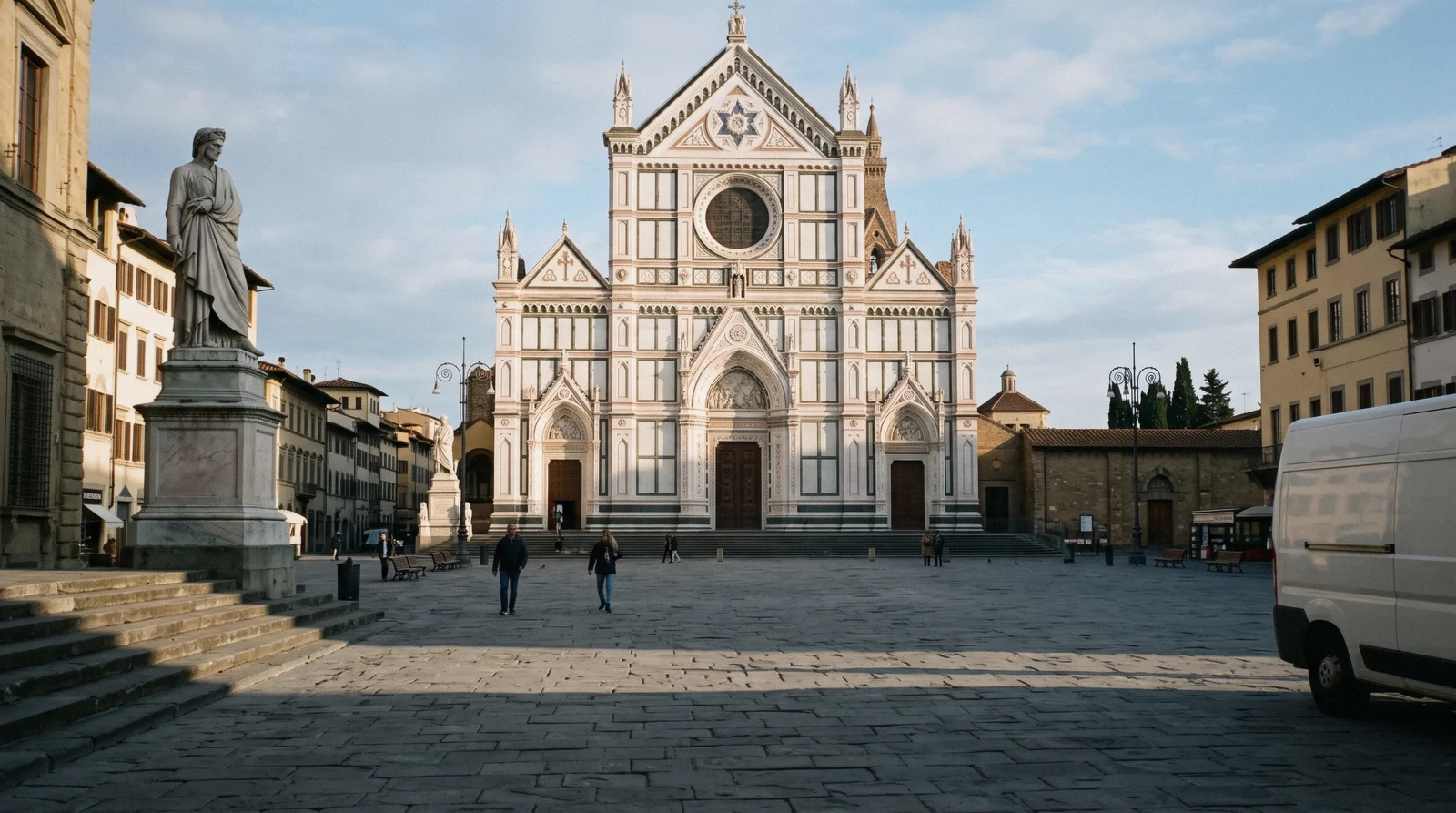
Basilica of Santa Croce
The Basilica of Santa Croce Florence is the Franciscan church on the eastern edge of the centre where Michelangelo, Galileo, Machiavelli and Rossini are buried, and where Giotto frescoed the Bardi and Peruzzi chapels. One entry covers the church, the cloisters, Brunelleschi's Pazzi Chapel and the museum in the old refectory, entry is €10 (about $12), and the guided visit with fast-track entry is from €36 (about $42). This page — part of the Florence city guide, see what to see in Florence — is about the monument: the hours, the price, the tombs and the route in. The square's leather workshops, restaurants and market are covered on the Santa Croce neighbourhood page.
Quick answer Hours, price, the tombs and how long — in three lines
Santa Croce opens Monday to Saturday 09:30–17:30 and Sunday only from 14:00, with the last entry at 17:00 and one closed day a year, 25 December. The basilica's own estimate for a visit is roughly 50 minutes, and no timed slot exists. Entry is €10 (about $12), and the guided visit with fast-track entry is from €36 (about $42).
Key takeaways
- One entry covers the church, both cloisters, the Pazzi Chapel and the refectory museum together. Every way in is in the table.
- Michelangelo, Galileo, Machiavelli and Rossini are buried along the nave and Dante has a cenotaph here, not a grave — what is in each tomb. Giotto's Bardi Chapel is under restoration in 2026, so the Peruzzi Chapel is the Giotto you will actually see.
- Shoulders and legs must be covered and free disposable robes are handed out at the door. If you want the church explained rather than read, the 90-minute guided visit with fast-track entry is the one to take; a walk that only passes the square is the €12 Medici tales walk.
Key facts
Opening hours
| Monday–Saturday, all year | 09:30–17:30 |
|---|---|
| Sundays and religious holidays | 14:00–17:30 |
Closed 25 December
Admission
- Adult
- €10 (about $12) at the church. Dress rule: shoulders and legs covered, free disposable robes at the door
- Reduced
- €6 (about $7) for ages 12–17, university students, groups of 15 or more, school groups
- Free
- Under 12 (the rules page says under 11), Florence residents, visitors with a disability and their carer, Firenzecard holders, licensed guides, journalists, religious, ICOM members. Free days in 2026: 15 August, 14 September, 26–27 September, 4 October, 8 November, 20 December, 26 December
Planning it
- Time needed
- About 50 minutes (the basilica's own figure); 1 h 15 if you read the tomb inscriptions and sit in the Pazzi Chapel
- Book ahead
- Optional — walk-up usually fine
- Address
- Piazza Santa Croce 16, 50122 Firenze
Ways into Santa Croce
Two ways in that include the entry ticket, both with a guide, with prices and cancellation terms as the listings show them, in euro, converted from the listed price. Neither is a timed slot for the church itself.
Do you want the tombs, or the tombs with someone naming who is in them?
| Option | Price | Includes | Rule | Book |
|---|---|---|---|---|
| Guided visit, 1.5 hoursVisitors who want the Pazzi Chapel and the frescoes read properly | €36 | Fast-track entry, certified guide, English, Spanish or Italian | Free cancellation to 24 h | Check Availability |
| Church tour with entry ticket, 1 hourPeople with exactly an hour who want a guide and the ticket bought once | €48 | Entry ticket, guide, radio headsets, four languages | Free cancellation to 24 h | Check Availability |
The Firenzecard costs €85 (about $99) for 72 hours and includes Santa Croce, so read whether the Firenzecard pays off against the museums you actually plan to enter.
Guided visits and walks that include the square
Two of these enter the basilica with a guide and a ticket; the two walks pass the façade and the piazza without going in, which is stated on their listings rather than implied here. Prices, ratings and review counts are the platform's own figures.
 from €36
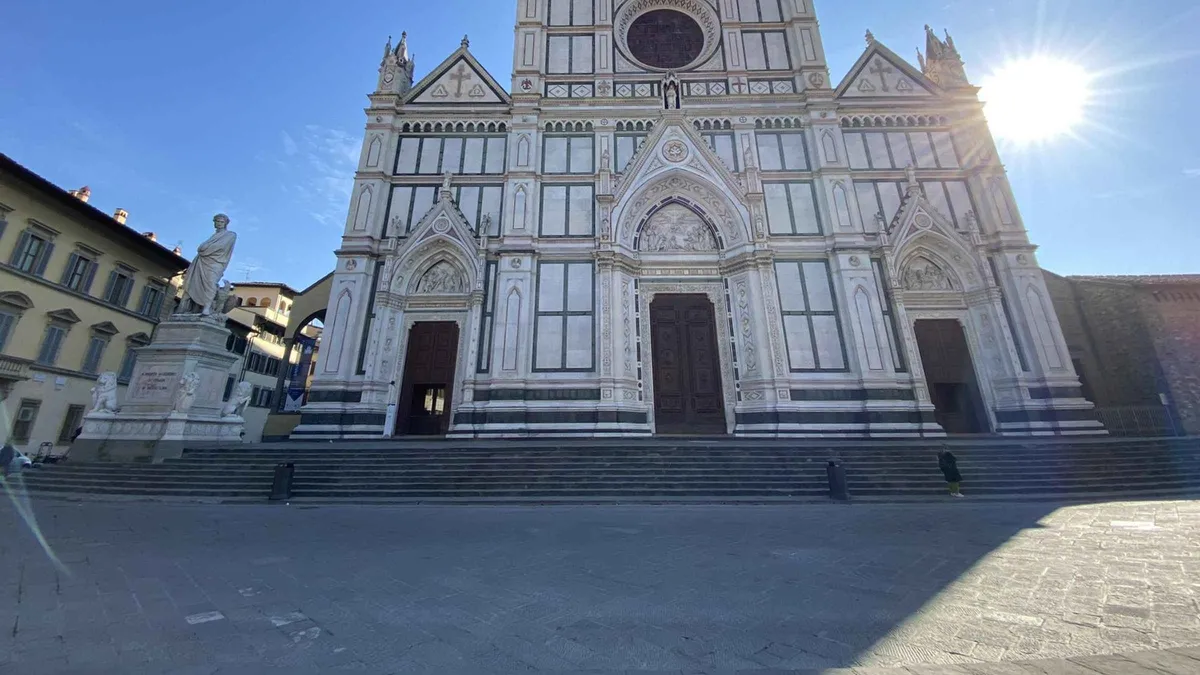
Florence: 1.5-hour Santa Croce Guided Experience
listed at $41.61
90-minute guided Santa Croce visit with fast-track ticket; Giotto frescoes, Galileo and Michelangelo tombs. English, Spanish or Italian.
Check Availability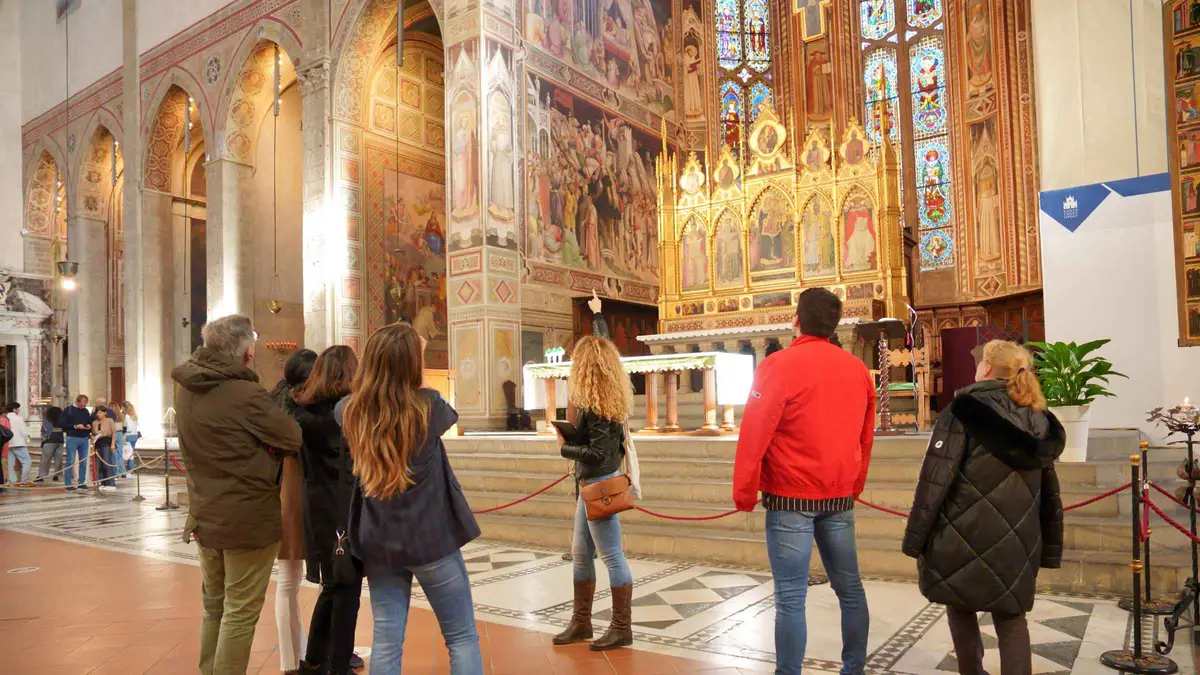 from €48
Florence: Santa Croce Church Tour with Entry Ticket
listed at $55.60
One-hour Santa Croce tour with reserved entry ticket and radio headsets; four guide languages. Wine-and-appetizer option on some dates.
Check Availability from €17
Florence: Highlights Walking Tour with Expert Guide
listed at $20.27
90-minute small-group highlights walk (Duomo, Piazza della Signoria, Ponte Vecchio) in 8 languages, with free luggage storage. Runs rain or shine.
Check Availability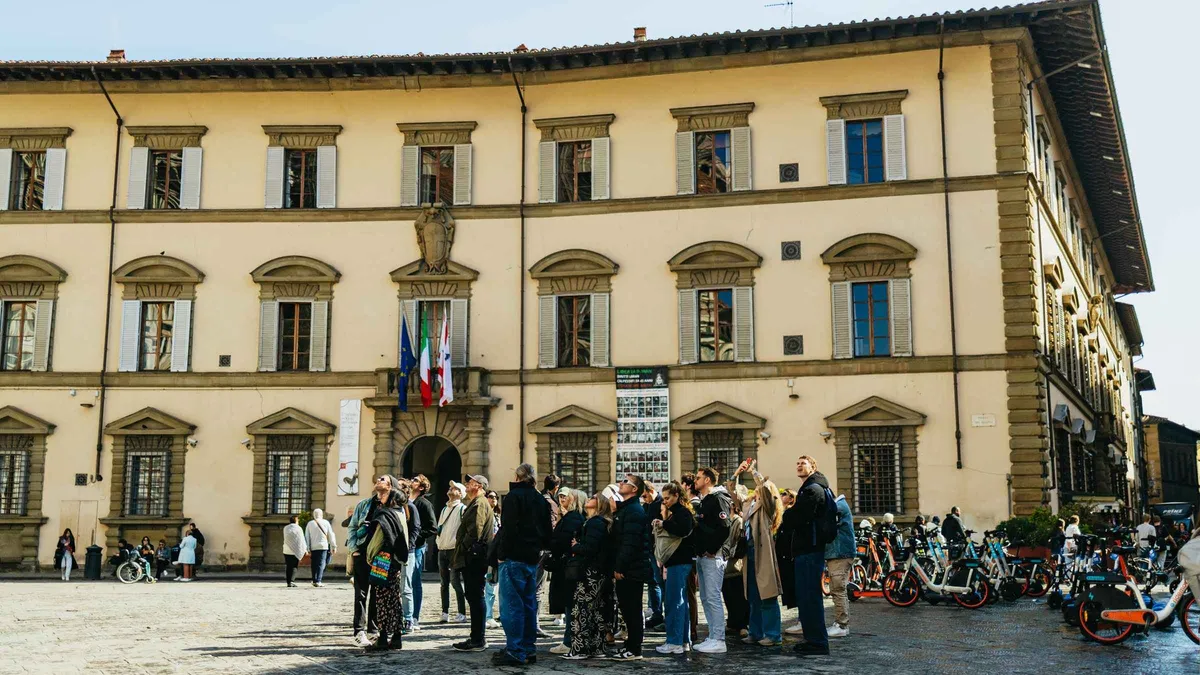 from €12
Top rated
from €12
Top rated
Florence: Renaissance and Medici Tales Guided Walking Tour
listed at $13.90
Two-hour storytelling walk on the Medici and the Renaissance in English or Spanish, ending with local eating and shopping tips. Cheapest tour here.
Check Availability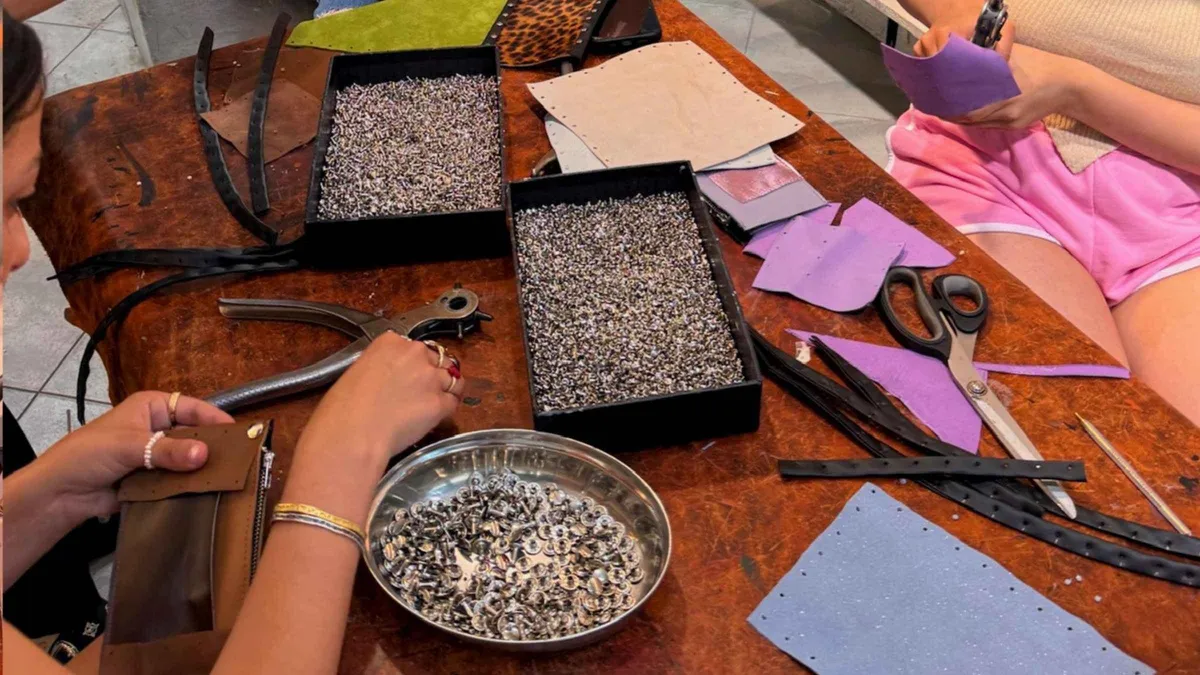 from €84
Florence: Craft a Leather Wallet in a Real Artisan Studio
listed at $98.46
2.5-hour wallet-making workshop in a working Florentine leather studio, max 4 people; all materials, coffee and your finished wallet. Chain upgrade €10 on site.
Check AvailabilityPrices, ratings and details are the platform's own. Dollar figures are the listed prices. The platform bills in your account's currency.
Why Santa Croce matters: the burial church of the Italian dead
It is the principal Franciscan church of Florence and the largest Franciscan church in the world, with sixteen chapels around a wide, wooden-roofed nave. What makes it unusual is not the architecture but who ended up under the floor.
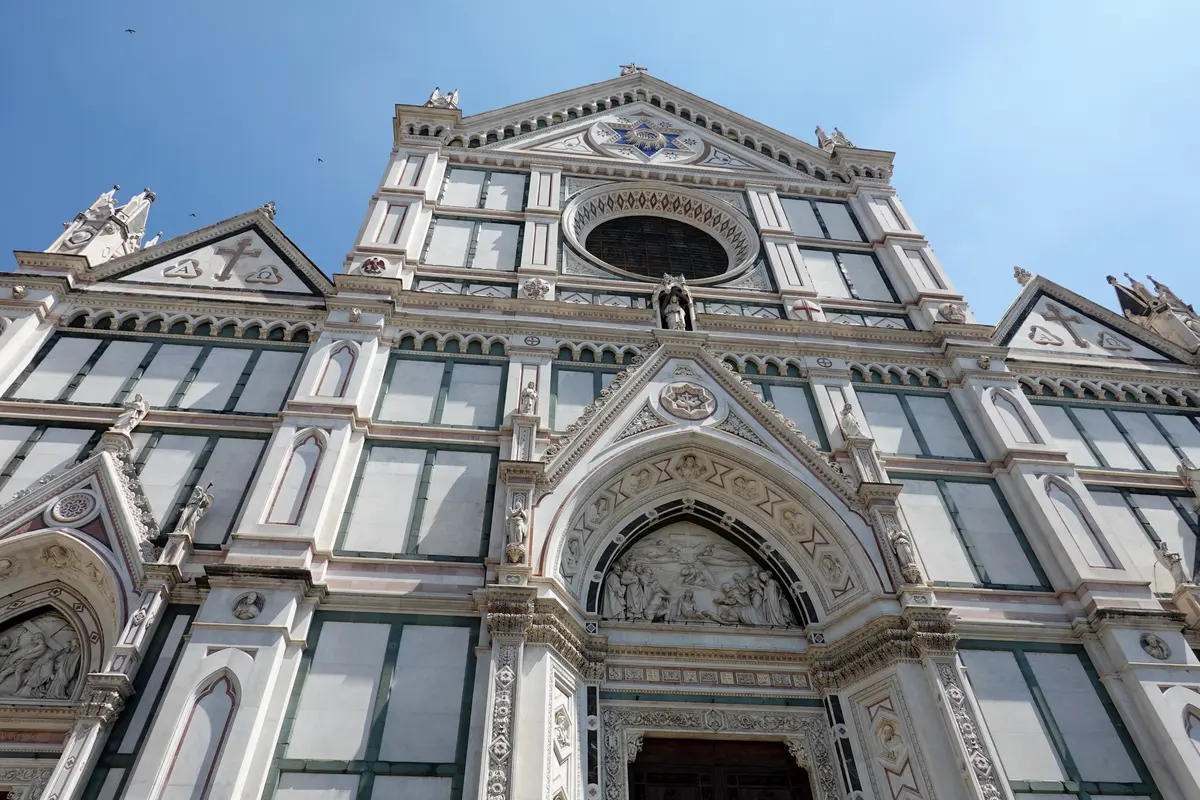
Photo: Prof. Mortel, CC BY 2.0, via Wikimedia Commons (https://creativecommons.org/licenses/by/2.0)
A preaching barn that became a national monument
The Franciscans built wide and plain on purpose: a single high nave with an open truss roof carries a voice to a standing crowd better than a vaulted one, and the sixteen chapels along the transept were paid for by the banking families who wanted their names beside the altar — Bardi, Peruzzi, Baroncelli, Pazzi. The building was finished and consecrated in 1442.
In 1560 Cosimo I had Giorgio Vasari strip out the choir screen that had divided lay congregation from friars, and the nave you walk down today is the space that operation opened up. The tomb monuments were then arranged along the side walls, which is why they read like a gallery rather than a graveyard.
The façade is much younger than the church behind it: Niccolò Matas designed the polychrome marble front between 1857 and 1863, and the bell tower went up in 1842. Both were built when Florence was about to become the capital of a new Italian state and the church was being turned, deliberately, into its pantheon.
November 1966: the flood mark you can still find
Santa Croce sits low and close to the Arno, and on 4 November 1966 the flood put water, mud and heating oil through the church and the refectory. Cimabue's great painted Crucifix was the most famous casualty; what survived of it hangs in the refectory museum today and is shown as a damaged object rather than a restored one, which is the honest way to show it.
The restoration effort — the mud angels, the volunteers who carried panels out of the water — is part of why this complex has a museum at all. Look for the flood-level plaques on the walls of the piazza and the surrounding streets: the water reached well above head height on this side of town.
The tombs: Michelangelo, Galileo, Machiavelli, Rossini — and Dante's empty one
The monuments line both side walls of the nave. They are not all graves, and the difference matters: two of the most photographed are memorials to men buried somewhere else entirely.
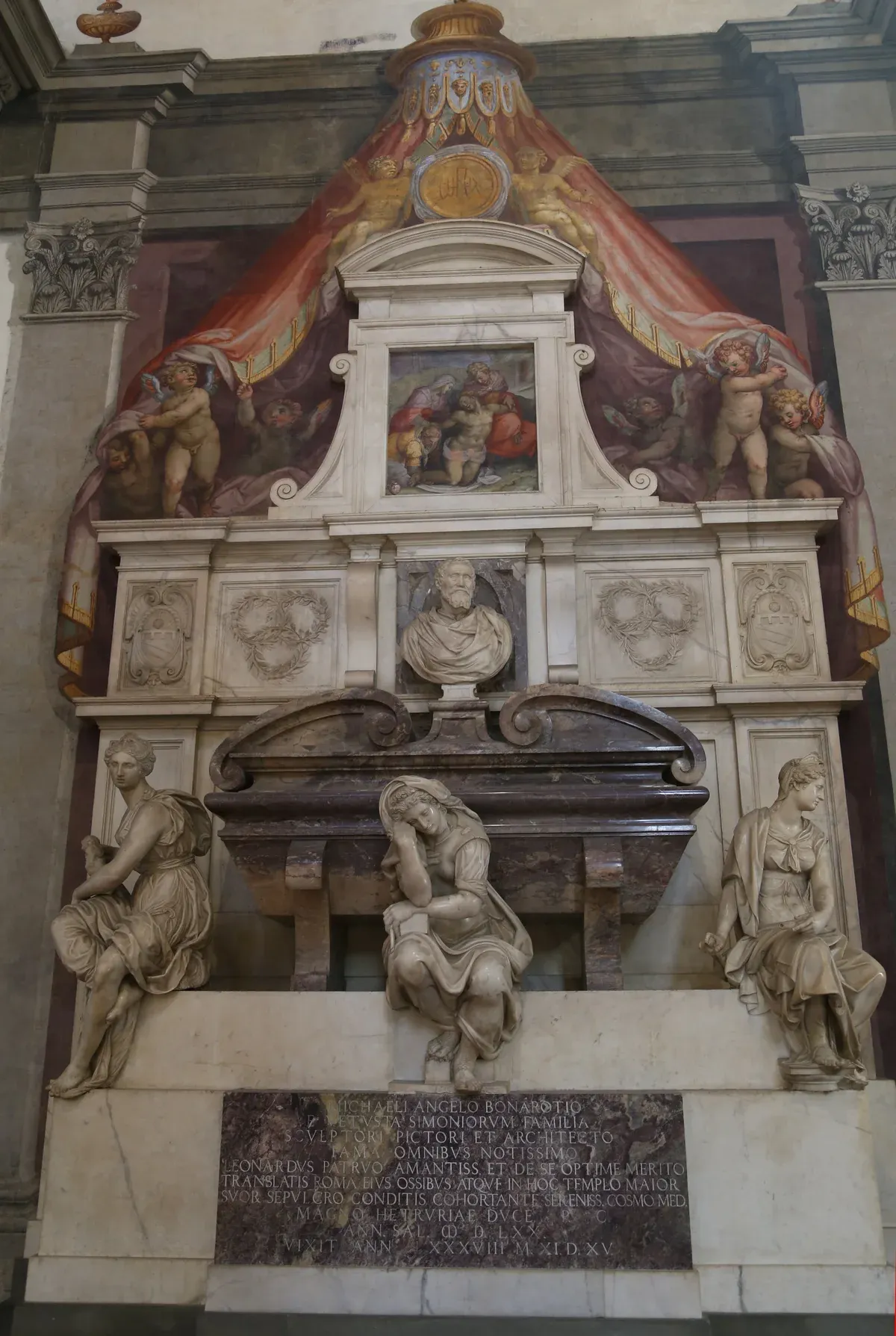
Photo: Rufus46, CC BY-SA 3.0, via Wikimedia Commons (https://creativecommons.org/licenses/by-sa/3.0)
Michelangelo, on the right as you enter
Michelangelo died in Rome on 18 February 1564, aged 88, and his last request was to be buried in Florence, so his body was brought back here. Cosimo I de' Medici commissioned the tomb the same year, and that commission is why this church is full of monuments: it started the grand-ducal habit of honouring the city's great names in Santa Croce, which the later tombs of Galileo, Machiavelli and Rossini followed. Giorgio Vasari designed the monument, finished in 1576, with the three seated figures, Painting, Sculpture and Architecture, carved by Valerio Cioli, Giovanni Bandini and Battista Lorenzi.
It is the first tomb on the right-hand wall, which is a piece of staging: the Florentine who left is placed where every visitor meets him first.
Galileo, opposite, and the century he had to wait
Galileo Galilei's monument stands on the left wall, near the entrance and directly across from Michelangelo. He died in 1642 under house arrest after his condemnation, and his remains were only moved into the body of the church long afterwards. The pairing across the nave — the artist and the astronomer — is the single most reproduced image of this church, and it is the reason a physics-minded traveller comes here at all.
Machiavelli, Rossini and the rest of the wall
Niccolò Machiavelli's monument, carved by Innocenzo Spinazzi in 1787, carries the line about no eulogy matching such a name. Gioachino Rossini's tomb, by Giuseppe Cassioli, is a nineteenth-century addition of the same nation-building impulse as the façade. Further along are the humanist Leonardo Bruni's tomb by Bernardo Rossellino and Carlo Marsuppini's by Desiderio da Settignano — the two wall tombs that art historians come specifically to see, and that most visitors walk past.
In the cloister there is also a monument to Florence Nightingale, who was born in the city in 1820 and named after it.
Dante is not buried here
The large seated Dante monument you meet in the nave is a cenotaph of 1829 — an empty tomb. Dante died in exile in Ravenna in 1321 and Ravenna has never given him back. The statue outside on the left of the façade, the one everybody photographs from the piazza, is also nineteenth-century.
If somebody tells you Florence's greatest poet lies in Florence's pantheon, this is the sentence that corrects them.
Giotto, Donatello and the Pazzi Chapel: what to look at once the tombs are done
The ticket covers far more than the nave, and most people leave the second half unused. Give the cloisters twenty of your fifty minutes.
Giotto's chapels — and which one you can see in 2026
Two chapels at the east end were frescoed by Giotto: the Bardi Chapel with the Life of St Francis and the Peruzzi Chapel with the lives of the two St Johns. The Bardi Chapel is under restoration, so treat the Peruzzi as the Giotto of this visit and check the basilica's news page before travelling if the Bardi is your reason for coming.
In the Bardi di Vernio chapel nearby, Maso di Banco frescoed the story of St Sylvester between about 1335 and 1338 — a Giotto pupil working at close to Giotto's level, in a chapel almost nobody enters.
Donatello: the Cavalcanti Annunciation and the wooden Crucifix
Donatello's Cavalcanti Annunciation is a gilded limestone relief set into the right-hand nave wall, an angel and a Virgin caught in the half-second after the sentence lands. His wooden Crucifix hangs in the Bardi di Vernio chapel; Vasari tells the story of Brunelleschi calling it a peasant on a cross and carving his own in reply, the one that hangs in Santa Maria Novella. Seeing both in one day is a good afternoon.
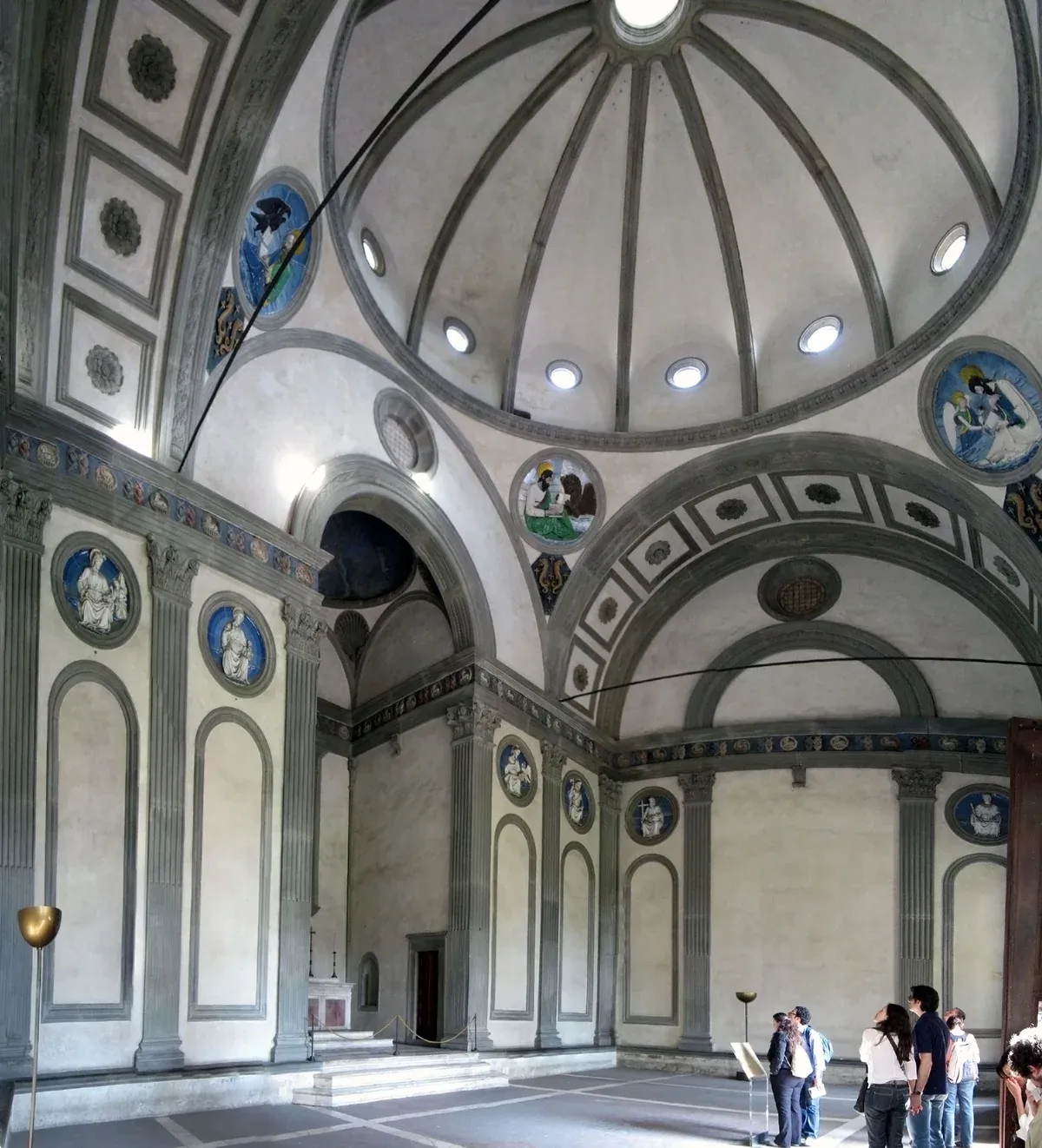
Photo: Gryffindor, CC BY-SA 3.0, via Wikimedia Commons (https://creativecommons.org/licenses/by-sa/3.0)
The Pazzi Chapel, in the first cloister
Walk out of the church into the first cloister and the Pazzi Chapel is straight ahead: a small domed chapter house of the 1470s built to a design associated with Brunelleschi, with grey pietra serena framing white plaster and Luca della Robbia's glazed terracotta roundels of the apostles around the walls. It is the quietest room in the complex and the one to sit down in — most visitors put their heads round the door and leave.
The refectory: Taddeo Gaddi's Last Supper and the Cimabue Crucifix
The museum occupies the old refectory, where Taddeo Gaddi painted a Last Supper below a Tree of Life around 1340 — the prototype for every Florentine monastic refectory that followed. The damaged Cimabue Crucifix is here too. The former dormitory next door houses the Scuola del Cuoio, the leather school founded after the Second World War, which you can walk into from the cloister; the workshops and shops of the quarter around it are covered on the Santa Croce neighbourhood page.
Hours, the Sunday rule and the 2026 free days
Two things catch people out here: Sunday afternoon opening, and free days that are not the first Sunday of the month like the state museums.
Santa Croce opens Monday to Saturday 09:30–17:30 and Sunday and religious holidays 14:00–17:30. Last entry is 17:00 on every day, so an arrival at 17:15 buys nothing. The only annual closure is 25 December.
On the free days the complex runs shorter: no online booking, tickets collected on site, and last entry pulled back to 16:30. The 2026 dates are 15 August, 14 September, 26–27 September, 4 October, 8 November, 20 December and 26 December. Note that these have nothing to do with the state-museum first-Sunday scheme that covers the Uffizi and the Accademia — a free Sunday at the Uffizi is a normal paying day here.
The dress rule is written down and enforced at the door: shoulders and legs covered. Free disposable robes are handed out if you arrive in a vest and shorts in August, which is the usual August scene on the steps. Other Florence churches vary; the comparison of every church's price, hours and dress rule sets them side by side.
- Monday–Saturday 09:30–17:30, last entry 17:00
- Sunday and religious holidays 14:00–17:30, last entry 17:00
- Closed 25 December only
- Free days 2026: 15 August, 14 September, 26–27 September, 4 October, 8 November, 20 December, 26 December — on site only, last entry 16:30
- Official visit estimate: about 50 minutes
How to get there, and where the door is
The entrance is on the piazza at Piazza Santa Croce 16, on the right-hand side of the façade as you look at it — not through the central bronze doors, which are the church's own. The ticket desk is inside that entrance, and the exit puts you back out through the cloister shop. The basilica is about 800 metres east of the Duomo, which is a ten-minute walk down Via del Proconsolo and Borgo dei Greci, past the Bargello.
From Santa Maria Novella station allow twenty minutes on foot; the C1 and C2 electric minibuses run through this part of the centre, and under the new fares in force since 1 August 2026, an urban bus or tram ticket costs €2 (about $2.30) for 90 minutes, or €3 if you buy it from the driver. Route letters change, so check the stop sign rather than trusting a blog, including this one. Do not drive to it.
The whole centre is a ZTL, closed to unauthorised cars Monday to Friday 07:30–20:00 and Saturday 07:30–16:00, with a summer night closure Thursday to Saturday 23:00–03:00 from the first Thursday of April to the first Sunday of October. Hotels inside the zone register your plate at reception; everyone else parks outside it. The getting around page has the fares and the zone in full.
For a visit to the basilica with commentary along the way, the Florence guided tours listed on the florence tours page often include Santa Croce among their stops.
- Entrance: right of the façade, Piazza Santa Croce 16
- 10 minutes on foot from the Duomo, 20 from Santa Maria Novella station
- Urban bus or tram €2 (about $2.30), valid 90 minutes; €3 on board
- ZTL: Monday–Friday 07:30–20:00, Saturday 07:30–16:00
Santa Croce map: the entrance and what is around it
The basilica entrance, the Pazzi Chapel inside the cloister, and the three stops most people pair with a visit here.
Next stop from Santa Croce
Walk minutes are our estimates from the GPS distances. The exit through the cloister shop puts you on the north side of the complex, closest to the Bargello.
Bargello
Donatello's marble and bronze Davids and Michelangelo's Bacchus in a former prison courtyard. The Bargello is the natural sequel to the Donatello reliefs here, and reserved entry is on the Bargello page.
5 min walkPiazza della Signoria
Straight along Borgo dei Greci to the Loggia dei Lanzi and the David copy. Piazza della Signoria costs nothing and stays open all night.
7 min walkThe Santa Croce quarter
Leather workshops, Sant'Ambrogio market and the trattorie behind the piazza: the Santa Croce neighbourhood covers where to eat and shop once the basilica shuts at 17:30.
On the doorstepSanta Croce questions
Is it free to enter the Basilica of Santa Croce?
No. Ages 12 to 17, university students and groups of fifteen or more pay a reduced rate, and entry is free under 12, for Florence residents and for Firenzecard holders. The basilica also runs its own free days in 2026 — 15 August, 14 September, 26–27 September, 4 October, 8 November, 20 December and 26 December — with tickets issued on site and last entry at 16:30. The guided visit with fast-track entry is from €36, and every way in is in the table.
Who is buried in Santa Croce in Florence?
Michelangelo, Galileo Galilei, Niccolò Machiavelli, Gioachino Rossini, Leonardo Bruni and Carlo Marsuppini, among others — the monuments run down both walls of the nave. Dante Alighieri is not: his monument here is a cenotaph of 1829 and he is buried in Ravenna. Which tomb is which and where it stands.
Is Santa Croce Florence worth visiting?
For fifty minutes, yes, provided you know what you are paying for. Santa Croce is worth visiting for the tombs, for Brunelleschi's Pazzi Chapel and for Donatello's Cavalcanti Annunciation, not for a spectacular interior: the nave is wide, wooden-roofed and deliberately plain. If your list is short and your interest is architecture rather than history, the Duomo complex gives more for the money; if it is the people buried in Florence, nothing else comes close. What is inside, chapel by chapel.
How long do you need at Santa Croce?
The basilica's own figure is roughly 50 minutes, which covers the nave and a quick loop of the cloister. Allow 1 h 15 if you want to read the tomb inscriptions, sit in the Pazzi Chapel and see the refectory museum properly. The 90-minute guided visit uses the time on the art rather than on finding things.
Is Santa Croce open on Sunday?
Only from 14:00. Sunday and religious-holiday hours are 14:00–17:30 with last entry at 17:00, so a Sunday morning here is wasted — put the Duomo complex or a walk on the morning instead and come after lunch. The full weekday table is in the hours section.
Is there a dress code at Santa Croce?
Yes, and it is checked at the door: shoulders and legs covered. Free disposable robes are handed out to anyone who turns up in a vest or short shorts. The cathedral applies the same rule plus a ban on flip-flops, as the Duomo page explains, while other churches in the city do not state one at all — the comparison is on the Florence churches page.
Can I see Giotto's frescoes at Santa Croce right now?
Partly. The Bardi Chapel with the Life of St Francis is under restoration, and the Peruzzi Chapel next to it is the Giotto cycle you can currently expect to see. Maso di Banco's St Sylvester frescoes in the Bardi di Vernio chapel are also open and almost empty. What to look at, chapel by chapel.
Does the Santa Croce ticket include the Pazzi Chapel and the museum?
Yes. One entry covers the basilica, the two cloisters, the Pazzi Chapel and the refectory museum with Taddeo Gaddi's Last Supper and the Cimabue Crucifix. There is no church-only ticket. The ways in include the entry with a guide.
Where are the leather shops and restaurants around Santa Croce?
The Scuola del Cuoio is inside the complex itself, in the former dormitory off the cloister. Everything else — the leather workshops of Borgo dei Greci and Via Torta, Sant'Ambrogio market six minutes north-east and the trattorie behind the piazza — is on the Santa Croce neighbourhood page.
Santa Croce on video
Three walk-throughs that show the nave, the tombs and the cloister before you decide how long to give it.
Santa Croce, room by room
An art historian walks the nave and the chapels, which is the fastest way to see what the entry ticket actually covers.
Video: Rocky RuggieroThe tombs of Michelangelo, Galileo, Dante and Machiavelli
A close look at the monuments along both walls, including the Dante cenotaph that holds nobody.
Video: Hoosier ToursInside the basilica in 4K
A quiet walk-through with no commentary — useful for judging how much of your 50 minutes the cloister deserves.
Video: The Silent TravellerWhere Santa Croce fits in a Florence day
It is an afternoon church. The Duomo complex and the state museums want your morning slots, Santa Croce takes walk-ups until 17:00, and the quarter around it is where the city eats afterwards — so the natural shape is Bargello at 14:00, Santa Croce at 15:30, dinner in the streets behind the piazza. On a Sunday, flip it: nothing here opens before 14:00.
If you are pairing churches, Santa Maria Novella at the other end of the centre holds Masaccio's Trinity and Brunelleschi's Crucifix and costs €7.50, and San Miniato al Monte above the river is free and sings vespers at 18:30 — a full church day with an evening. The three-day Florence itinerary places this visit on its second afternoon, and the whole attractions list ranks it against everything else by time needed. Every church in the city with its price, hours and closed day is compared on the Florence churches page, and the rest of the guide starts from top things to do in Florence.
Prices, hours and terms are set by the venue or operator and confirmed at checkout.
We may earn a commission if you book through one of our links, at no extra cost to you. Full affiliate disclosure