 Florence City Guide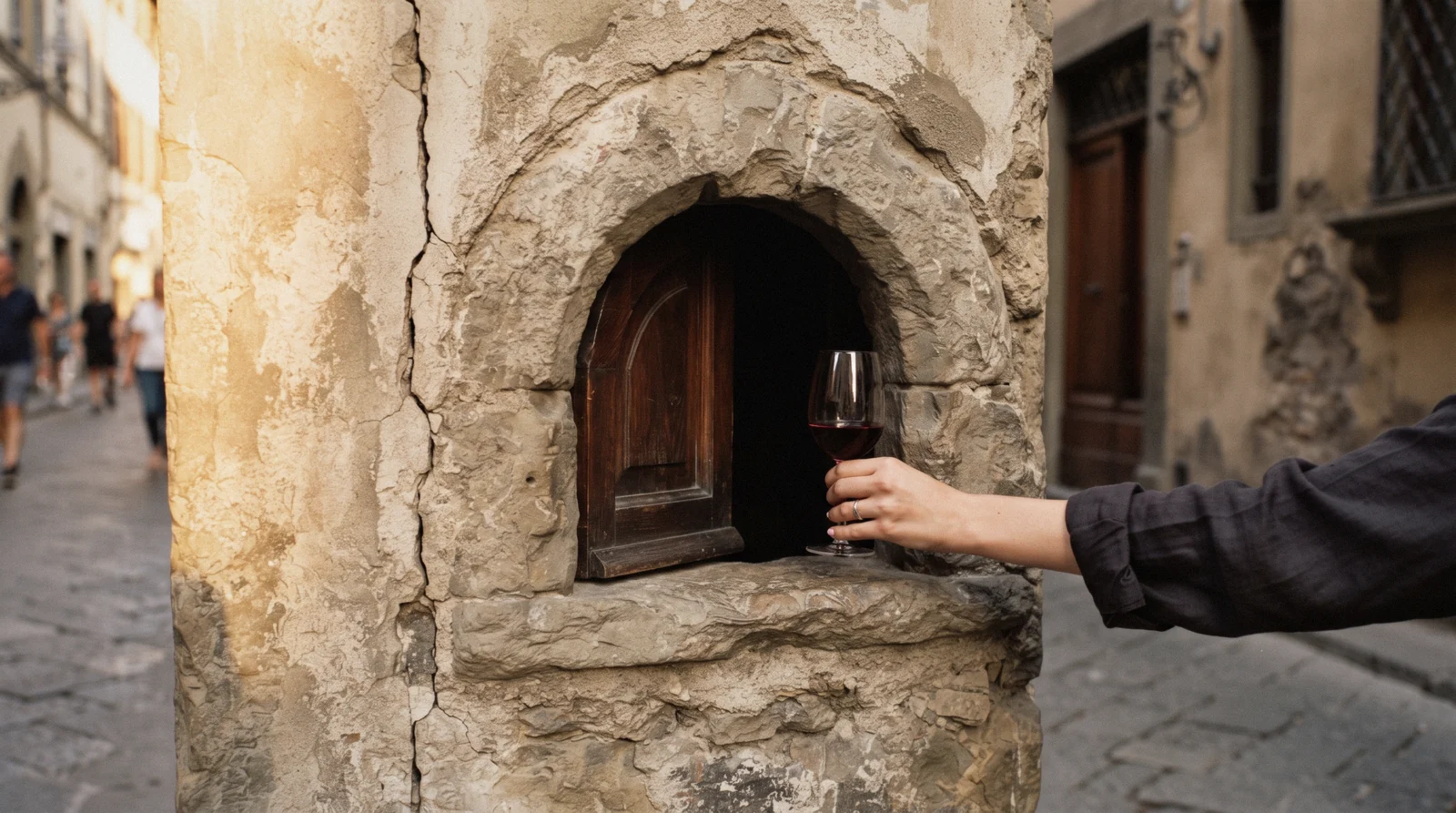
Wine Windows in Florence
The wine windows in Florence, the buchette del vino, are small arched hatches in palace walls that once passed the family's own wine to the street. The association that counts them has 192 on record in the city, and 14 bars and restaurants still serve through theirs on request. This page pins every window that pours, tells the plague story from the 1634 source and gives you a walk past eight of them. It is one of the things to see in florence we cover in depth. For the wider food picture, see what Florentines eat and how the bill works.
Quick answer 192 on record, 14 still pour: where they are and what to expect
Florence has 192 wine windows on the Buchette del Vino association's census of 16 December 2025, 164 inside the old walls and 28 outside. Twenty-two bars and restaurants have a genuine one on their premises, and 14 of them still serve through it on request during their own hours. No venue publishes a price, so ask at the hatch.
Key takeaways
- The census counts 164 windows inside the old walls, 28 outside and 111 removed, and 14 venues still pour on request
- They date from the sixteenth century, when palace families sold their own wine at the door. In the 1630 plague sellers took coins on a metal pallet and washed them in vinegar. Read the history
- To see several with a licensed guide, book the city highlights walking tour with the wine windows option, €28 (about $33), or pour at a window on the sunset food and wine evening in the Oltrarno
Florence's Wine Windows in Numbers
Every figure below comes from the Associazione Buchette del Vino census dated 16 December 2025. It is the only list that exists: the association notes that the windows have never been catalogued in any public archive of the Italian state, the Region of Tuscany or the City of Florence.
| What | Count | Where it comes from |
|---|---|---|
| Inside the old walls | 164 | Census |
| Outside the walls, within city limits | 28 | Census |
| Recorded but removed | 111 | Census |
| Elsewhere in Tuscany | 121 in 37 localities | Census |
| Bars and restaurants with a genuine window | 22 (association count) | Association venue list |
| Of those, serving through it on request | 14 | Association venue list, marked red |
The Florence list numbers 192 windows in total, which is 164 inside plus 28 outside. Older figures on the association's home page (more than 180) predate this census. Figures current in Q3 2026.
Walk the Windows With a Guide
Nothing of ours sells a glass at a window. What you can book is a licensed guide who routes you past the palaces, or an Oltrarno food evening whose wine tasting includes a pour from a window.
 from €28
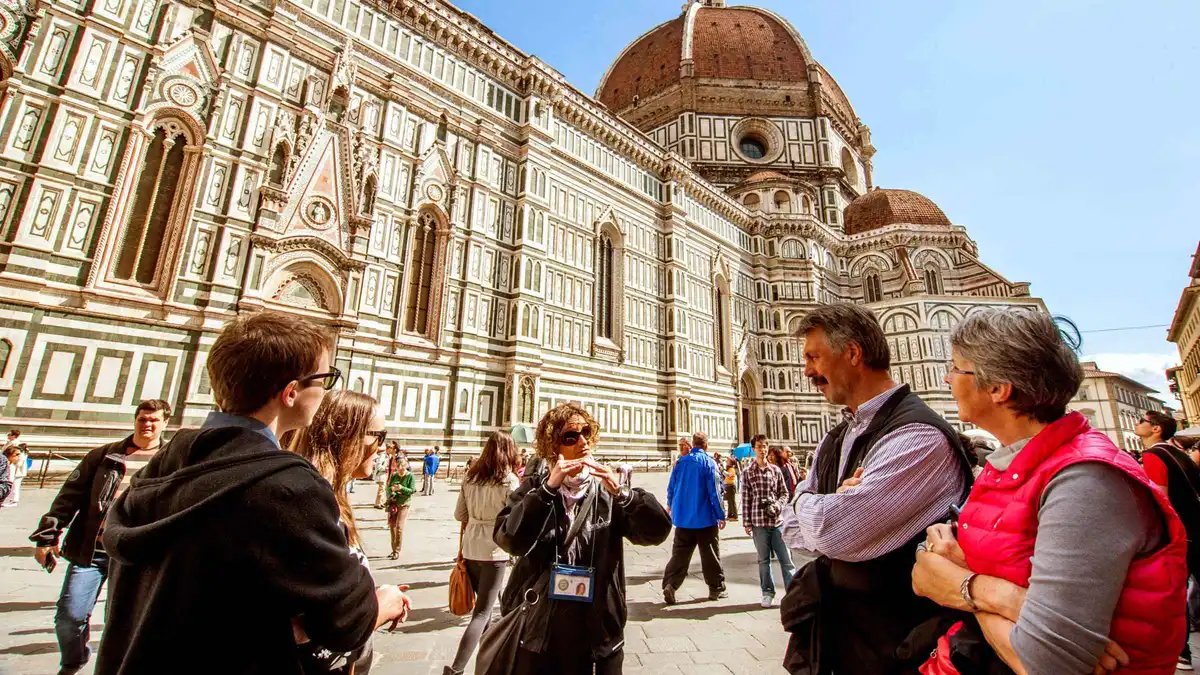
Florence: City Highlights Walking Tour & Wine Windows Option
listed at $33.00
1.5-2 hour walking tour of Florence's center with a licensed guide; the Wine Windows option adds a tasting and a glass of wine at a historic wine window. Monuments are viewed from the outside only.
Check Availability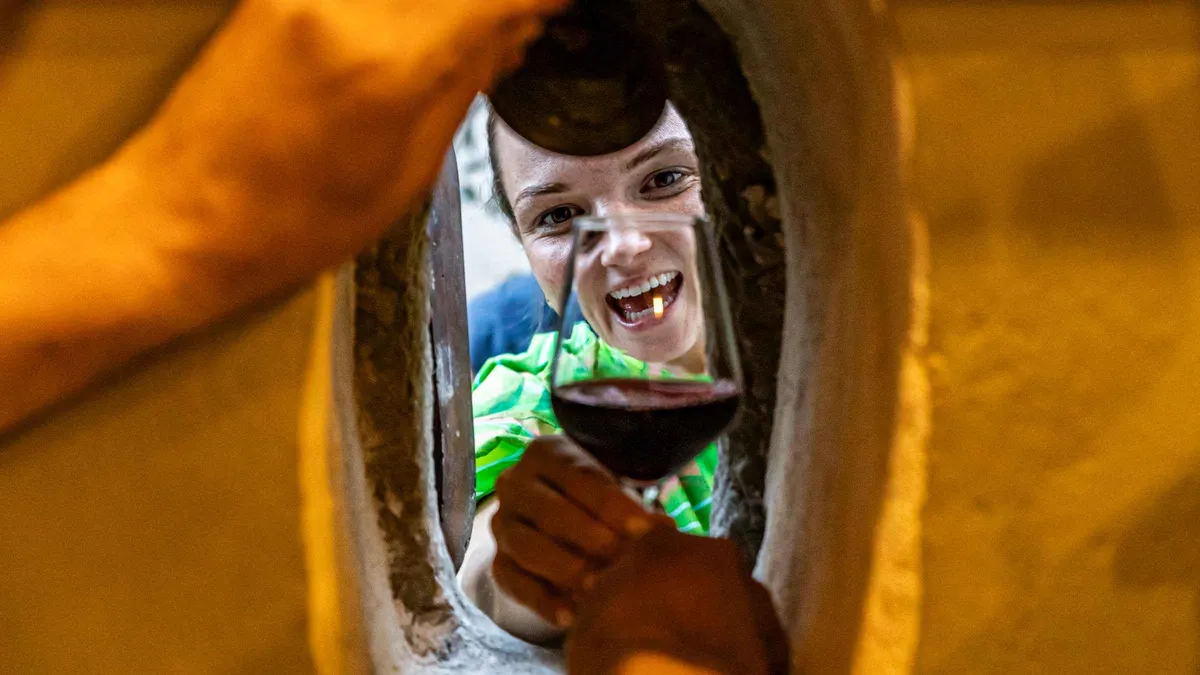 from €108
Florence: Sunset Food & Wine Tour with Tastings
listed at $126.26
3.5-hour Oltrarno food and wine walk at sunset: prosecco welcome, Negroni, 4 wines from a wine window and cellar, cheeses, wild boar stew, gelato.
Check Availability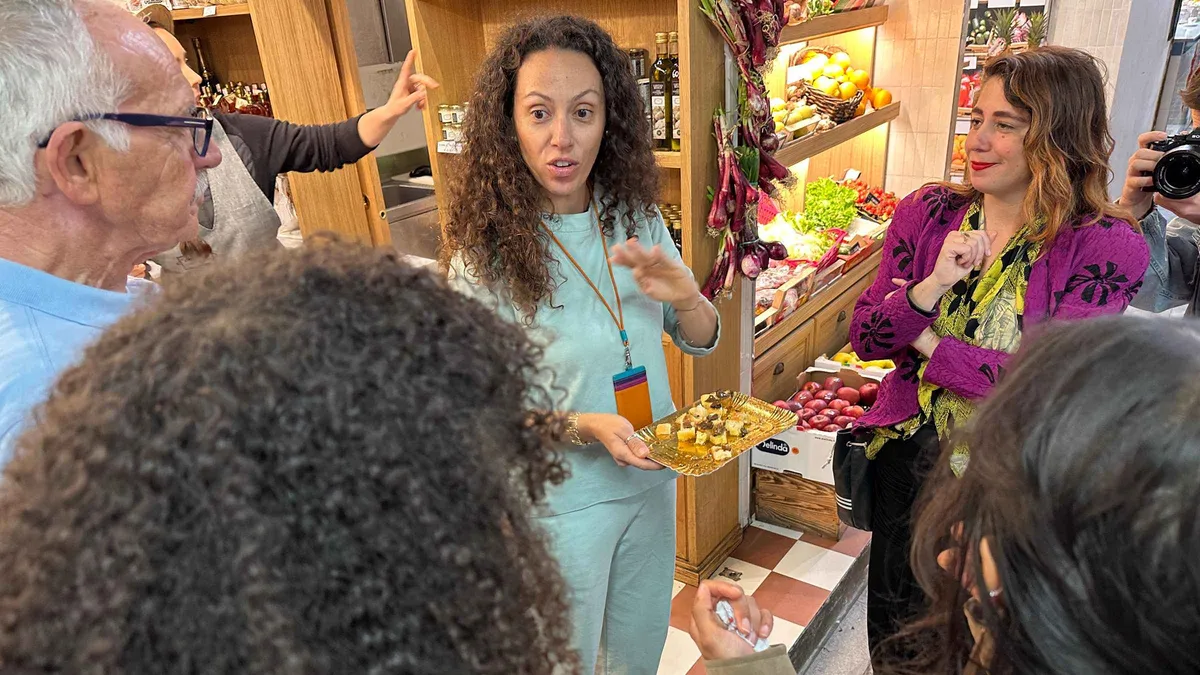 from €42
Top rated
from €42
Top rated
Florence: Street Food Tour with Wine & Local Guide
listed at $48.65
2.5-hour street-food walk through San Lorenzo Market and the Duomo area with several tastings and a sip of wine; morning only, no vegan or gluten-free.
Check Availability from €53
Top rated
from €53
Top rated
Florence: Street Food Walking Tour with Wine
listed at $62.55
2.5-hour licensed-guide street-food walk with tastings and drinks included, past the Duomo and Ponte Vecchio. Not for vegans or gluten intolerance.
Check AvailabilityPrices, ratings and details are the platform's own. Dollar figures are the listed prices. The platform bills in your account's currency.
What a Wine Window Is, and How to Spot a Real One
The Shape of the Thing
A real buchetta is an arched opening about 20 x 30 cm, large enough to pass a small wine bottle. It sits next to the main door of a landowning family's palace, usually at eye level though a few are at foot level, and it was often cut into the door itself with a small wooden shutter and a knocker. Most were connected to the cellar, so the flask travelled from barrel to street in one motion.
No two are alike. The association plans a small brass plaque by each genuine window giving the address, palace name, materials and date.
Watch Out for the Fake Ones
The association prints the warning in capitals on its venue list. New windows have been built around the world, from Epcot to Vancouver to Buenos Aires, and some openings in Florence itself served other purposes. Its own test is the sharpest line on the subject: every wine window is a sportello, but not every sportello is a wine window.
A real one sits beside the main door of a family palace, usually at eye level, and was linked to a cellar. If an opening has none of that and no number on the census, treat it as decoration and use the map on this page instead.
From Palace Cellars to the Plague: The History
Where They Came From
The origin is uncertain. The association ties the windows to the Medici return to power in 1532, which let wealthy landowners sell their own wine directly to customers. The first documented record of direct bottle sales in the palaces of wine-producing families dates from 1559, under Cosimo I, but that document does not mention the windows themselves, so nobody can date the hatches to a single year.
National Geographic reports that a document of 1596 found in a local archive is the oldest on record. What is certain is the trade they served: the family's own harvest, sold at the door, for four centuries.
The Plague Years
The windows' best-documented moment came during the plague of 1630 to 1633, which killed 12 percent of Florence's population according to National Geographic. Francesco Rondinelli's account, published in 1634, describes wine sellers passing the flask out but taking no coins by hand. The client placed the coins on a metal pallet and the seller disinfected them with vinegar.
The wine went out either in pre-filled bottles or through a metal tube from the demijohn behind the wall. Rondinelli calls the opening a sportello, the word the association still uses in its test for a real window.
The Long Decline
Travellers noticed the trade. John Evelyn's diary of 1644 records the Grand Duke selling his own wine from the palace cellar, Tobias Smollett mentions it, and Lady Morgan describes it in her book Italy of 1821. Occasional use lasted into the early 1900s, after four centuries and millions of bottles.
Then shops selling bulk wine undercut the palaces, plastic containers and cheaper wine arrived, sharecropping ended, and the 1966 flood put ground-floor cellars out of use. No law decreed their demise, in the association's words. They simply stopped being worth opening.
The Comeback
Matteo Faglia, Diletta Corsini and Mary Christine Forrest founded the Buchette del Vino association in October 2015 and began counting. Then the 2020 lockdown, which began on 8 March, gave the windows a second use: on reopening, owners including Babae and Vivoli passed wine, cappuccino and gelato through their hatches without contact. CBS and BBC World covered it, hundreds of articles followed, and Stanley Tucci was filmed at Babae's window for his Searching for Italy series.
The census that followed numbers 192 windows in the city, and the association plans a small brass plaque beside each genuine one.
Wine Windows, Dated
The dates that matter, with the sources named.
-
1532
Medici return
The association's hypothesis: the returning Medici let landowners sell their own wine direct.
-
1559
First record of palace bottle sales
Direct sale of wine in bottles in producing families' palaces. The document does not mention the windows.
-
1630 to 1633
Plague
Twelve percent of the city dies. Windows serve as contact-free counters.
-
1634
Rondinelli's report
Rondinelli's account of the plague: coins on a metal pallet, disinfected with vinegar.
-
1644
John Evelyn's diary
The English traveller records the Grand Duke selling his own cellar wine at the palace.
-
1821
Lady Morgan's Italy
Lady Morgan describes the trade in her book Italy.
-
Early 1900s
Last occasional use
Four centuries of retail and millions of bottles end in occasional use.
-
1966
The flood
The flood puts ground-floor cellars out of use. No law ends the windows.
-
October 2015
Association founded
Faglia, Corsini and Forrest begin the census.
-
8 March 2020
Lockdown
Italy locks down. On reopening, Babae, Vivoli and others pass wine, coffee and gelato through their windows.
-
16 December 2025
Census
The association's Florence list numbers 192 windows in the city.
Sources: Associazione Buchette del Vino census and news pages, and National Geographic's reporting on the windows.
The 14 Windows That Still Pour
These are the venues on the association's red list: genuine windows in working bars and restaurants that serve through the hatch on request. The number in brackets is the window's number on the Florence census. Knock or ring, order what the venue offers, and remember that none of them publishes a price or a window timetable. Walking times are our reading of the census coordinates.
Babae (135)
The census places this window in palazzo Manetti at Via Santo Spirito 23, a 20 x 33 cm opening, while the bar itself gives its address as Via Santo Spirito 21/R. Babae is the window the 2020 story made famous: when Italy reopened after the lockdown, it passed wine and cappuccino through the hatch without contact, and National Geographic reports that Stanley Tucci was filmed drinking at it for Searching for Italy. That is why the line forms in the evening. Service is on request during the bar's own hours, and its website prints no window price, so ask at the hatch.
It sits in the Oltrarno, 5 minutes on foot from Fiaschetteria Fantappiè.
DiVin Boccone (34)
Via delle Caldaie 30r, in casa Amerighi, on a side street of the Oltrarno about 6 minutes south of Babae. The association lists it in red, which means the window has been reopened and serves on request during the venue's hours. It is not among the venues the association names in its account of the 2020 reopening, and no television crew has made it famous, so it is the quieter of the south-bank pours.
Casa Amerighi is a house rather than a grand palace, a reminder that the census covers more than the great family seats. Fiaschetteria Fantappiè is 3 minutes away, and no price is published.
Fiaschetteria Fantappiè (145)
Via de' Serragli 47r, the farthest of the Oltrarno pours from the river. A fiaschetteria is named for the fiasco, the Tuscan wine flask, and Rondinelli's 1634 account describes exactly that trade: the flask passed out through the wall. The census gives no palace name or measurement for this window, only its number and address, and the association marks it red, reopened and serving on request.
DiVin Boccone is 3 minutes away and Babae 5, so the three Oltrarno windows make one short loop. Hours are the shop's own, and like every venue on this list it publishes no price for window service.
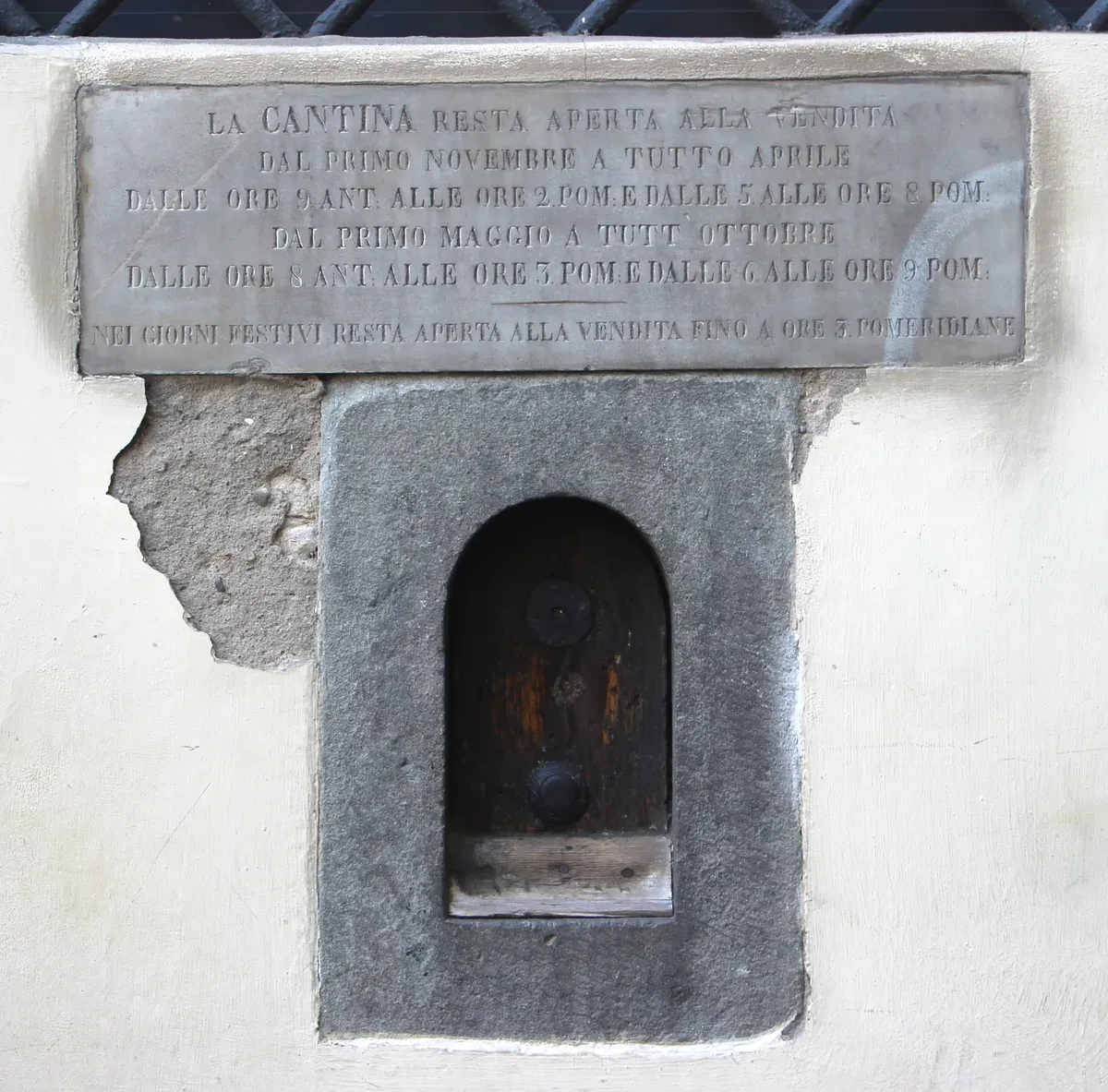
Photo: Francesco Bini, CC BY-SA 4.0, via Wikimedia Commons (https://creativecommons.org/licenses/by-sa/4.0)
Osteria delle Belle Donne (27)
Via delle Belle Donne 16r, in palazzo Giacomini Larderel. At 22.5 x 34.5 cm the window is a little larger than the typical 20 x 30 cm the association describes. The osteria serves through it on request during its opening hours, with no published price.
The same street holds a second pouring window at 43r, 2 minutes away. At Via delle Belle Donne 2 another wine window, pictured here, still carries the cellar's marble plaque of selling hours: 9 to 2 and 5 to 8 from November to April, 8 to 3 and 6 to 9 from May to October, and until 3 on feast days. It is the clearest evidence on this page of how the trade ran.
Osteria e Vinaino Cicalone (28)
Via delle Belle Donne 43r, the second pouring window on this short street and, at 30 x 50 cm, the largest the census measures on the red list, big enough to pass more than a small bottle. The census names no palace here. The association marks it red: reopened and serving on request during the osteria's hours, with no published price.
Palazzo Antinori's closed window, with vino cut into the stone, is about a minute's walk away, so this is the place to see a working hatch and a retired one back to back. Il Latini's two windows are 3 minutes off, and Osteria delle Belle Donne 2.
Ristorante Il Latini (87-88)
Via dei Palchetti 2 and 4, in palazzo Rucellai. The census gives it two numbers, 87 and 88, and it is the only venue on the red list with two windows, measuring 22 x 33 and 22 x 34 cm. Il Latini is one of the venues the association names among those that used their windows during the 2020 reopening, passing drinks and food out without contact.
It is also a Bib Gourmand table in the MICHELIN Guide 2026, carded on our where to eat page and routed from the guide-listed tables, so the hatch and the dining room are one stop. Service is on request during the restaurant's hours. Osteria delle Belle Donne is 2 minutes away.
Cafè Odeon (149)
Piazza degli Strozzi 8r, in palazzo dello Strozzino, on the square in front of Palazzo Strozzi. At 18 x 28.5 cm this is the smallest window the census measures on the red list, just under the 20 x 30 cm the association gives as typical, which it describes as large enough for a small wine bottle. The café serves through it on request during its own hours, with no published price.
It is a 3-minute walk from Osteria delle Belle Donne and about 9 from Cantina de' Pucci, so it sits naturally in the middle of a centre walk, and it fits between an exhibition at the palazzo and dinner without a detour.
Caffè Duomo (44)
Piazza del Duomo 29r, in palazzo Naldini Del Riccio, the only window on the red list that faces the cathedral square itself. It measures 20.5 x 32 cm, close to the typical size the association gives. The café marks it red on the association's list: reopened, serving on request during opening hours, price not published.
Because it is on the square every visitor crosses, it is the easiest window in the city to find, and the quickest way to see what a buchetta looks like before you hunt the quieter ones. Cantina de' Pucci is 2 minutes away and Ristorante Grande Nuti 4. For the cathedral itself, see our Duomo page.
Cantina de' Pucci (109)
Via de' Pucci 4, in palazzo Pucci, a 19.5 x 31.5 cm window on the kind of family palace the association describes, where the owners sold their own wine at the door. A cantina is a cellar, and the name matches the link to the cellar behind the wall that the association says most windows had. The venue is on the red list and serves on request during its hours, with no published price.
It is 2 minutes from Caffè Duomo and 3 from Ristorante Grande Nuti, which makes the three the tightest cluster north of the cathedral, and it is where the walk further down this page finishes.
Ristorante Grande Nuti (116)
Borgo San Lorenzo 22, on the street between the cathedral and the church of San Lorenzo. The census gives no palace name or size for this window, only its number and address, and the association marks it red: reopened and serving on request during the restaurant's hours. That makes it one of three pouring windows within 4 minutes of each other, with Cantina de' Pucci 3 minutes away and Caffè Duomo 4.
It is also the closest pour to the market streets, about 4 minutes from the Mercato Centrale and close to San Lorenzo. As everywhere on this list, no price is published.
Vivoli Gelateria (67)
Via dell'Isola delle Stinche 7r, in palazzo Lottini, in the Santa Croce district. Vivoli is one of the two venues the association names first in its account of the 2020 reopening, when it passed gelato out through the window without contact, and the reopened windows were covered by CBS and BBC World. A window that sells ice cream rather than wine is the clearest sign of how far the use has moved.
It measures 20 x 30.5 cm. Service runs during the shop's own hours, and its website prints no window price. Osteria San Fiorenzo is 2 minutes away, the start of the Santa Croce cluster.
Osteria San Fiorenzo (64)
Borgo dei Greci 1a, in casa Peruzzi, a 20 x 33 cm window on the red list. The Peruzzi name appears twice in this cluster: Ristorante Pietrabianca's window is in palazzo Peruzzi on the square about a minute away, so two Peruzzi buildings still pour within a few steps of each other. The osteria serves through its window on request during opening hours, with no published price.
La Buchetta Food&Wine is 2 minutes away and Vivoli 2 in the other direction, so all four Santa Croce windows fit in well under ten minutes of walking. It sits in the middle of the Santa Croce four, so it is the easiest place to start.
Ristorante Pietrabianca (94)
Piazza Peruzzi 1, in palazzo Peruzzi, a 19.5 x 31.5 cm window on the red list. Piazza Peruzzi also appears in the association's 2020 account, which names Osteria delle Brache on the same square among the venues that served through a window that year. Today the square's working window is Pietrabianca's, serving on request during the restaurant's hours with no published price.
It sits about a minute from Osteria San Fiorenzo and a minute from La Buchetta Food&Wine, the tightest spacing anywhere on this list, so you can see three pouring windows here in the time it takes to finish a glass.
La Buchetta Food&Wine (127)
Borgo Santa Croce 11r. The census lists La Buchetta Food&Wine twice, here at number 127 and at number 29 on Via de' Benci, where the window is inside the premises and not in service, so check which door you are at. The Borgo Santa Croce window is the one on the red list, serving on request during opening hours with no published price.
The census gives no palace name or measurement for it. The venue takes its name from the window itself: buchetta is the word the association uses in its own name, Buchette del Vino. Ristorante Pietrabianca is about a minute away.
Wine Windows Florence Map
Every window on this map is taken from the association's Florence census. Rust pins are the fourteen venues that still pour, the green pin is Palazzo Antinori's closed window. For the full list of 192 there is the association's own Florence PDF and its interactive Google map, with a separate Tuscany map.
Genuine Windows You Can Only Look At
Seven more venues hold genuine windows that no longer serve. They are on the association's blue list, and one palace window is worth the detour anyway.
Palazzo Antinori
The best-known closed window is on palazzo Antinori, census number 159, at Vicolo del Trebbio 1 off Via del Trebbio, where National Geographic reports the word vino engraved on the stone and Marchese Piero Antinori dates the window to the sixteenth century. It no longer serves. The census entry sits with Ristorante Buca Lapi, the restaurant in the same palace, which the association lists in blue: a genuine window on the premises, not in use.
It is about a minute from Osteria e Vinaino Cicalone and 2 minutes from Osteria delle Belle Donne, so fold it into the walk below rather than making a separate trip.
The Dense Streets
Three streets carry the highest concentration on the census. Via de' Bardi, south of the river, has eight entries on one street, one of them inside Cantina del Gelato at number 31. Borgo degli Albizi also has eight.
In 2019 the association counted six on Borgo degli Albizi, the same number as on Via Santo Spirito, where Babae's window is. Most of these are closed shutters in stone frames rather than working hatches. Walk them with your eyes at door height, and lower too, since a few windows sit at foot level, then match each frame to its number on the association's Florence PDF list.
The blue-list venues, all with a genuine window on the premises that is not currently in use.
- The association's list is the only register of these windows, and it records whether a venue serves, not what it serves
- For more free things to look at on foot, our free things to do in Florence page picks up where this one stops
| Venue (census no.) | Address |
|---|---|
| Cantina del Gelato (22) | Via de' Bardi 31 |
| Gelateria Royale (24) | Largo Bargellini 5 |
| La Buchetta Food&Wine (29) | Via de' Benci 3, inside |
| Trattoria Osteria da Que' Ganzi (54) | Via Ghibellina 80 |
| Burgez (69) | Via de' Macci 77r |
| Finisterrae (91) | Via de' Pepi |
| Ristorante Buca Lapi (159) | Vicolo del Trebbio 1, palazzo Antinori |
Ordering at a Window: What to Expect
The Ritual
Knock or ring at the hatch, since many windows keep the small door with a knocker the association describes. Its rule for the fourteen red-list windows is that service happens on request during the venue's own opening hours, so there is no separate window timetable anywhere in the city. What comes out depends on the venue: during the 2020 reopening, owners passed wine, coffee, drinks, sandwiches and ice cream through, and each menu is the venue's own.
Vivoli passes gelato, Babae poured wine and cappuccino, and most of the others pour wine. If the shutter is closed during opening hours, ask inside at the counter.
Price and Payment
Here is the negative finding, stated plainly: no venue publishes a per-glass price for window service on its own website. Babae and Vivoli have sites and print none, and most of the others have no site at all. Figures on blogs and forums are not from the bars, so this page prints none.
Payment is the same story: no venue states how it takes money at the hatch, so treat cash or card as the bar's own rule and ask before you order. The historical answer is the 1634 one, coins on a metal pallet washed in vinegar. The modern one is to look at the board or ask.
A One-Hour Walk Past Eight Pouring Windows
This route links eight red-list venues from the Oltrarno across the river to the centre, using the census addresses. Walking times are our reading of the census coordinates, at an easy pace.
The Route
Start at Babae on Via Santo Spirito and walk 6 minutes south to DiVin Boccone on Via delle Caldaie, then 3 minutes to Fiaschetteria Fantappiè on Via de' Serragli. From there it is 10 minutes across the river to Il Latini on Via dei Palchetti, in the centro storico. Two minutes on, the Belle Donne pair sit 2 minutes apart on the same street, with Palazzo Antinori's closed window a minute from the second.
Then 5 minutes to Cafè Odeon on Piazza degli Strozzi and 9 minutes to finish at Cantina de' Pucci near the cathedral. That is eight pouring venues and nine hatches in about 3 km and 37 minutes of walking, an hour with stops. Babae draws its line in the evening, so start there before it builds.
Once you have the route down, it folds easily into the wider sightseeing offered by tours in Florence, and you can browse the options at tours in Florence.
- To have a licensed guide do the routing, the city highlights walking tour with the wine windows option runs 1.5 to 2 hours for €28 (about $33), and the option adds a tasting and a glass at a historic window
- For a drink after the last hatch, our bars and nightlife page starts where this one stops
| Stop | Window (census no.) | Walk from previous |
|---|---|---|
| 1. Via Santo Spirito 23 | Babae (135) | Start |
| 2. Via delle Caldaie 30r | DiVin Boccone (34) | 6 min |
| 3. Via de' Serragli 47r | Fiaschetteria Fantappiè (145) | 3 min |
| 4. Via dei Palchetti 2 and 4 | Il Latini (87-88) | 10 min |
| 5. Via delle Belle Donne 16r | Osteria delle Belle Donne (27) | 2 min |
| 6. Via delle Belle Donne 43r | Osteria e Vinaino Cicalone (28) | 2 min |
| 7. Piazza degli Strozzi 8r | Cafè Odeon (149) | 5 min |
| 8. Via de' Pucci 4 | Cantina de' Pucci (109) | 9 min |
Near This Page
The food and neighbourhood pages that pair with a window walk.
Where to eat in Florence
What Florentines eat, how the bill works, and Il Latini's dining room.
Guide pageThe Oltrarno
Three of the fourteen pouring windows sit in this quarter, including Babae.
Guide pageThe Santa Croce district
Four windows on the red list cluster here, Vivoli's gelato window among them.
Guide pageBest restaurants in Florence
The guide-listed tables worth sitting down to after a glass at the hatch.
Guide pageWine Windows in Florence: Questions
How much does a glass from a wine window cost?
Not published. No venue lists a window price on its own website, and the association does not print one either. Look at the board or ask at the hatch before you order. More in the ordering notes.
How many wine windows are there in Florence?
The Buchette del Vino association's census of 16 December 2025 counts 192 in the city: 164 inside the old walls and 28 outside, with another 111 recorded but removed. Tuscany beyond Florence holds 121 more across 37 localities. The figures are in the numbers table.
Which wine windows still serve?
Fourteen venues on the association's red list serve through their windows on request during their own opening hours. All fourteen are listed and pinned in the pouring section, from Babae in the Oltrarno to Vivoli in Santa Croce.
Why were wine windows used during the plague?
For trade without contact. Francesco Rondinelli's 1634 account of the 1630 to 1633 plague describes sellers passing flasks out but taking no coins by hand: the client put coins on a metal pallet and the seller disinfected them with vinegar. The full story is in the history section.
How do I pay at a wine window?
Ask. No venue publishes how it takes payment at the hatch, so cash or card is the bar's own rule. The historical answer, from 1634, was coins disinfected in vinegar. The practical answer today is simply to check before you order.
What is on a wine window menu?
Whatever the bar serves. The association's own list mentions wine, spritz, coffee, gelato and sandwiches, and menus vary window by window. Vivoli passes gelato, most others pour wine. No window publishes a menu with prices.
Is there a map of the wine windows?
Yes. The map on this page pins the fourteen pouring windows and Palazzo Antinori's closed one, all from the census. The association also publishes a Florence PDF list of all 192 and an interactive Google map.
Are there fake wine windows in Florence?
The association warns to watch out for them. Some openings in the city served other purposes over the centuries, and new imitation windows have been built as far away as Epcot, Vancouver and Buenos Aires. Its test: every wine window is a sportello, but not every sportello is a wine window. Stick to the census.
Wine Windows on Video
Three videos that show you what the hatch ritual actually looks like before you join a queue.
FLORENCE WINE WINDOWS (self-guided tour + history)
A self-guided walk past the buchette that matches this page's map.
Video: Sophie NadeauI DRANK WINE THROUGH A 17TH CENTURY PALAZZO WALL! | FLORENCE WINE WINDOWS
The knock, the shutter and the glass, filmed at a palazzo window.
Video: JetSetJulietTravelsWine window in Florence
A short look at a single working hatch, the clearest preview of the ritual.
Video: The Roaming HistorianWe may earn a commission if you book through one of our links, at no extra cost to you. Full affiliate disclosure